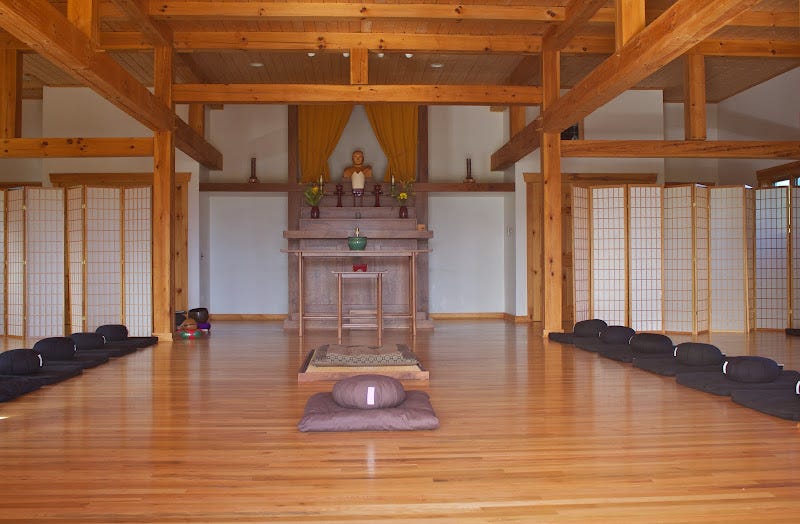
The first thing I remember is the incense.
Sandalwood, the most glorious I have ever smelled, somehow both clean and wooden at once. It filled the open Buddha hall: high ceilings, wood trim, the altar with the Buddha and the offering. On the floor, about thirty zabutons, the flat square mats used for sitting, each topped with a zafu, the round meditation cushion. Monks, priests, and lay people like me, all on the same floor. The abbot sat above us on the tan, the raised wooden platform, on his own cushion. He wore his regular brown robe, but with a bright orange cloth draped across it that I hadn’t seen before: his okesa. An okesa is the Buddha’s robe, a rectangular patchwork cloth that priests receive at ordination and wear draped over the left shoulder. The everyday ones come in muted browns and blacks. The bright ones come out for ceremony.
And here’s what surprised me. I expected solemnity. What I found was smiling. The whole room hummed with eager anticipation, but the mood wasn’t heavy. It felt like the minutes before something joyful. Something about it reminded me of stakeholder meetings I’ve sat in at agricultural cooperatives, or scorecard workshops where a community gathers around its own data: everyone with a role, formality in service of belonging, the sense that whatever happens next belongs to the whole room.
This is part three of a four-part series about what I learned from the Dragon Gate. Part one was about oryoki and the knot. Part two was about chanting the lineage. This one is about a ceremony I was lucky enough to witness, and a koan I am still carrying.
Six months with one story
In a Zen practice period, one student serves as shuso, the head student for that season of training. It is a role, not a rank. The role passes to someone new each practice period, and serving as shuso is a rite of passage on the priest’s path, which means the room that day almost certainly held people who had once sat in that seat themselves, and some who will in the future. Among everything else that role asks, the shuso spends the practice period living with a single koan: one of the short, strange teaching stories that Zen students contemplate, often a recorded exchange between an old master and a monk. Not a semester’s reading list. One story, carried for six months, through every sitting, every meal, every work period.
At the end comes the ceremony, called hossenshiki, sometimes translated as dharma inquiry or dharma combat. The shuso receives the shippei from the abbot, a curved bamboo staff ordinarily reserved for a teacher who has been authorized to teach. For this ceremony, the teacher’s staff is in the student’s hands. He takes his seat. He reads the koan aloud. Another priest reads the accompanying verse. And then the room gets to ask him about it. Anyone. Question after question, in a formal call and response that has its own choreography, the way everything at the monastery does.
This is the koan our shuso carried, Case 44 of the Blue Cliff Record, a collection of one hundred koans compiled in China nine hundred years ago:
Ho Shan imparted some words saying, “Cultivating study is called ‘learning.’ Cutting off study is called ‘nearness.’ Going beyond these two is to be considered real going beyond.”
A monk came forward and asked, “What is ‘real going beyond’?” Shan said, “Knowing how to beat the drum.”
Again he asked, “What is the real truth?” Shan said, “Knowing how to beat the drum.”
Again he asked, “’Mind is Buddha,’ I’m not asking about this. What is not mind and not Buddha?” Shan said, “Knowing how to beat the drum.”
Again he asked, “When a transcendent man comes, how do you receive him?” Shan said, “Knowing how to beat the drum.”
I’m not going to explain it
That’s not me being coy. A koan is not a riddle with an answer key, and explaining one is a good way to kill it. The point is that you sit with it until it opens for you, and what it opens into is yours.
So I’ll only tell you what happened to me. I had almost no time with the koan before the ceremony, and I understood, honestly, nothing. Four questions, one answer, four times. That was as far as I got.
The first question came swiftly. I can’t remember exactly what it was. But the shuso’s answer was “knowing how to beat the drum.” Smiles all around the room. What you might not expect is that Zen priests have a sense of humor.
Then for the next half hour I watched the shuso answer for it. People asked about the history: who Ho Shan was, where the teaching came from. People asked intellectual questions about the meaning. And people asked about their own quotidian lives: work, family, the ordinary Tuesday afternoons of being a person. He met all of it. And somewhere in the middle of the questions, I understood more than I had. Not everything. More.
Now I want to do the slower thing. I want to really sit with it, and find out what it means for me. That part hasn’t happened yet, and I’m not going to rush it.
The examination that ends in blessing
Here’s the part of the ceremony I can’t stop thinking about as an evaluator.
The questioning was real. The shuso had to actually answer, in front of everyone, with no notes and no advance list of questions. The community was allowed to press him. And the whole time, the room was warm. People smiled. The form held everyone.
When the abbot was satisfied that the shuso had answered enough to show he understood, he told him that he had done well, and that he was fit to be a teacher. And then, one by one, the whole room congratulated him. It was one of the most emotional things I have ever been part of.
Sit with that structure for a second. It is an examination. It is rigorous, public, and unscripted. And its purpose, from the first stick of incense, is to confirm someone’s readiness and celebrate it. The accountability and the love are the same gesture.
Evaluation almost never feels like that, and I keep asking myself why not.
What the ceremony asks of evaluators
Two questions followed me home.
First: what would it mean to sit with one question for six months? Evaluation runs on a different clock. An RFP cycle, a data pull, a 30-day analysis window, findings due before the program has even stopped changing. We answer questions at the speed of contracts. The shuso lived with his question through six months of sittings and meals and chores, and when the ceremony came, the answers were in him, not in his notes. I think about the difference between analyzing a question and living with one. Most evaluations I’ve been part of did the first. The ones I’m proudest of got somewhere near the second.
Second: what would it mean to answer for our findings in the open? Not a briefing deck delivered upward to the funder, but a room where anyone can ask: the program staff, the community the data came from, the person whose life sits inside the percentages. History questions, method questions, and quotidian ones. When we serve findings only to the people who paid for them, we get to skip the hardest and most honest questions. The shuso didn’t get to skip anything. And because the room was rooting for him, he didn’t need to.
That’s the piece I want to steal: rigor whose endpoint is capacity, not verdict. An examination that ends with the community saying, one by one, we trust you to carry this now.
Still carrying it
I don’t have a tidy ending, because the koan isn’t done with me. That’s the honest state of things, and it feels right for a series about practice.
The verse that accompanies Case 44 ends with a warning I’ll leave here without comment:
Don’t be careless! The sweet is sweet, the bitter is bitter.
Sit with it. See what it does.
Part four is the last one: sitting practice itself, eight hours on a cushion over a weekend, and everything that comes up in waves when you finally stop moving.
Glad to be sitting with the question alongside you.
Anthralytic builds evaluation tools for communities that want to gather around their own data and answer for it together.