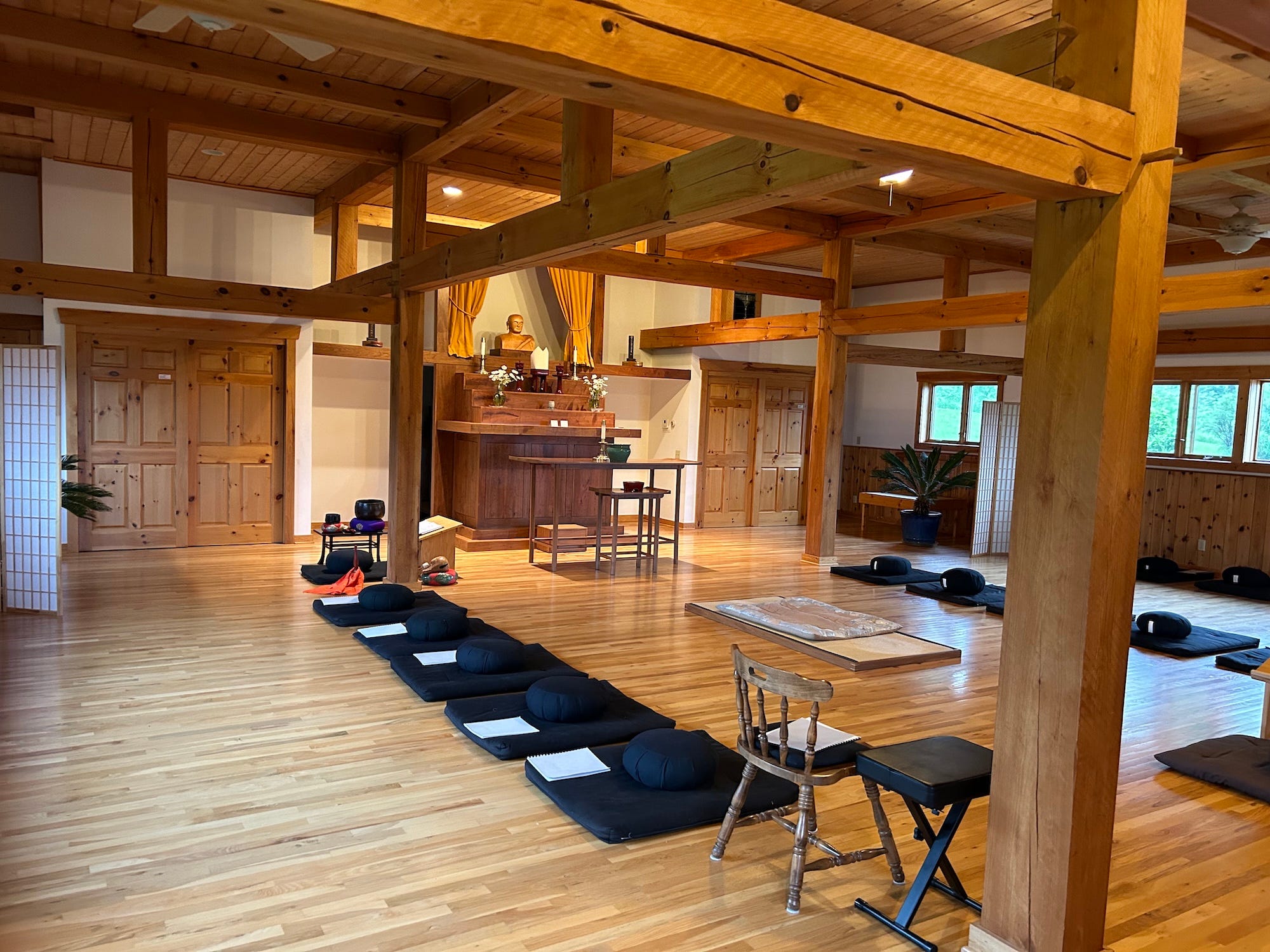
At Ryumonji I was surprised how meaningful chanting our lineage was for me.
Name after name, out loud, together. Beginning with Shakyamuni Buddha, then down through India, into China, across to Japan, and forward to Dainin Katagiri Roshi, whose dharma heir founded the monastery where we sat. Generations of them. Some of the names belong to people who died twelve centuries ago, and there I was, a lay practitioner from a small Midwestern sangha, saying them with my own voice.
Every name in the line was somebody’s teacher. Every name was first somebody’s student.
The bowls taught me about the meal. The chant taught me about time.
This is part two of a four-part series about what I learned from the Dragon Gate. Part one was about oryoki, the formal meal, and the knot I struggled with. This one is about the names.
Nobody wakes up alone
In modern Western culture, when we say lineage we usually mean blood. Family trees, ancestry charts, the DNA kit that tells you where your great-grandparents came from. That kind of lineage matters. It shapes who we are and what we inherit, chosen or not. But that’s not what this post is about. This post is about lineages of teaching, of craft, of practice. Not the lines you are born into, but the lines you are received into.
That is the line we chanted at Ryumonji. In Zen, the lineage chant is a record of dharma transmission: the teaching passed from teacher to student, face to face, in an unbroken line. Warm hand to warm hand, as the tradition says.
Historians will tell you parts of the early record are legend, and that’s fine, because accuracy isn’t really the claim. The claim is relationship. Nobody woke up alone. Every person in that line received the teaching from someone and handed it to someone else. When you chant the names, you’re not reciting a family tree. You’re acknowledging that what you have was given to you.
And here is the detail I keep returning to: everyone in the hall chants it. The abbot chants it. The monks chant it. The lay people chant it. The person who fought her oryoki knot at breakfast that same morning chants it. The lineage doesn’t belong to the credentialed few. It belongs to everyone in the room, because everyone in the room is downstream of it.
Evaluators have a lineage too
We just never chant it.
Imagine it for a moment. Tyler, who asked whether programs actually did what they promised. Campbell, who dreamed of an experimenting society. Scriven, who insisted that evaluation means judging merit and worth, and made us stop pretending otherwise. Weiss, who showed that findings take on lives of their own. Patton, who asked who would actually use any of this. Mertens, who demanded we center the people research had marginalized. Chilisa, Cram, Bowman, who showed that communities own their knowing and always have.
Each one building on the one before. Each one arguing with the one before. That’s what a lineage is. It isn’t agreement. It’s inheritance.
The evaluation field usually draws this as a theory tree, with branches for methods and use and valuing. I love the tree. But a tree maps positions. A lineage does something different: it says you received this. When you run a focus group or build a logic model or fight for a participatory process, you’re not just using a technique. Someone handed it to you. Someone handed it to them. And each handoff came with adaptations and additions, deletions and changes. Nothing in the line arrives untouched. That’s not corruption of the lineage; that’s how a lineage stays alive.
I met my ancestors in a graduate seminar
Here’s my confession: I only formally met this lineage last year, in a grad school class that walked through the theorists one by one.
By then I had been doing evaluation for years. Almost everything I know, I learned by doing: by writing the report, getting it wrong, sitting in the meetings, watching what actually helped and what just performed helpfulness. I didn’t have a singular teacher the way the monks at Ryumonji have theirs. There was no ceremony, no transmission, no unbroken chain of hands to mine.
And I don’t think I’m unusual. That’s how most evaluators come up. The lineage exists, but the field keeps it behind a credential, in graduate seminars many working evaluators will never sit in. At Ryumonji, nobody checked my qualifications before handing me the names. In evaluation, you can practice for a decade before anyone shows you whose shoulders you’ve been standing on.
But I realized when I returned from Ryumonji that I do have a lineage, but it isn’t a chain of personal teachers. It’s chosen. There are evaluators going back generations whom I subscribe to, each building on the others, and I took refuge in them through their books and their frameworks and their arguments. You adopt your ancestors in this field. And the learning-by-doing part has its own Zen echo, because nobody transmitted oryoki to me either. My hands learned the knot through repetition. The practice itself was the teacher.
So who’s in your line? Not who should be. Who actually is. It’s worth writing the names down. If you’re an evaluator, I invite you to try this exercise: write down your evaluation lineage, the people whose thinking your practice is built on, however you met them. And if you’re not an evaluator, whatever your vocation is, write yours. Teaching, nursing, coding, organizing, parenting. Every craft has a line behind it. See whose names surface.
The two chants
Now the harder part.
For most of Zen’s history, the lineage chant contained only men. The women were there the whole time, teaching, practicing, transmitting, but the formal records erased them. Grace Schireson, in her book Zen Women, describes the women’s line as a stream gone underground, surfacing again and again in different places, never granted a continuous record.
Then, in 2010, American Soto Zen did something remarkable. The Soto Zen Buddhist Association adopted a Women Ancestors Document: a recovered lineage beginning with Mahapajapati, the Buddha’s aunt and stepmother and the first woman ordained, running through the Indian, Chinese, and Japanese women the records had left out. Many centers now chant both lines. Fourteen centuries underground, and then a community sat down, wrote the names back in, and started saying them out loud.
Recovering a lineage is a choice. It is an act of repair.
Here is my second confession: I don’t know whether the women’s names were chanted at Ryumonji. I don’t have the chant book, and I can’t reconstruct it from memory. I can still hear the traditional line. I cannot tell you whether the recovered one was in the room.
That’s how absence works. It doesn’t announce itself. You have to already know the missing names to notice they’re missing.
Evaluation has its underground stream too. The community members whose insight became “findings” with no name attached. The local staff who collected the data and never appeared in the report. The practitioners whose methods were absorbed into the field without credit. We have one list we keep and one list waiting to be recovered, and most of us, most of the time, can’t say who’s on the second list. Not because we checked and found it empty. Because we never learned to notice.
So the question the two chants left me with: which list are we keeping? And who is waiting on the one we’d have to choose to write?
Saying the names out loud
I don’t have a ceremony to offer. But there are small ways to chant.
Name the people whose work yours builds on, and not just the famous ones. Put the local data collectors in the acknowledgments. Cite the community report, not just the journal article. Tell the new evaluator on your team where the method they’re learning came from, and who fought for it. And maybe stop keeping the lineage behind the paywall of a degree, because the names belong to everyone doing the work.
One more thing from the sesshin, for next time. I got to witness a ceremony in which the monastery’s head student answered questions from the whole community about a single koan he had spent six months living with. That koan begins with these words: “Cultivating study is called learning. Cutting off study is called nearness. Going beyond these two is to be considered real going beyond.”
All this study. All these names. And the teaching points past both. That’s where we’re going in part three.
The line doesn’t stop with us. Someone will chant our names, or won’t.
Glad to be standing in lineage with you.
Anthralytic is my way of passing the work along: evaluation software handed to resource-constrained organizations with fewer gates on it.