

Every program begins with hope. You see a problem, imagine a better future, and rally people and resources to make it real. That spark—the belief that change is possible—is what drives social impact work.
But between inspiration and impact lies a long stretch of ground. Funders want to know how you’ll cover it. Communities want to know why they should trust the process. And your own team needs to see how their daily work fits into the bigger picture.
That’s where a Theory of Change comes in.
A Theory of Change (ToC) is the bridge between vision and reality. It lays out, step by step, how your activities connect to the outcomes you care about. Not necessarily a glossy brochure (though it can be), but often a straightforward map of “if–then” logic: If we do X, then Y should happen. If Y happens, then Z becomes possible.
It’s not about jargon or compliance—it’s about credibility and a well thought-out strategy behind the change you want to see. A ToC helps people believe in your story of change, because you’ve shown them how it’s supposed to work.
What goes in a Theory of Change?
A strong ToC typically includes five building blocks:
Activities – What you actually do (trainings, services, advocacy).
Outputs – The immediate products of those activities (workshops held, farmers trained).
Outcomes – The changes those outputs are expected to spark (skills gained, behaviors shifted, policies adopted).
Impact – The long-term difference you aim for (healthier children, resilient communities, more accountable governance).
Assumptions – The if–then glue holding the map together: If farmers get better seed, then they’ll adopt new practices. If they adopt, yields increase. If yields increase, incomes rise.
Why it matters
It forces clarity.
Goals like “empowerment” or “resilience” sound inspiring, but what do they look like in practice? A ToC defines them in observable terms—like youth leading decision-making processes, or women accessing credit.
It aligns people.
Staff, board members, partners, and funders often picture success differently. A ToC creates a shared map so everyone sees how their part contributes to the whole.
It helps you adapt.
No program unfolds exactly as planned. When you’ve articulated the logic, you can see where things break down and adjust intelligently—without losing sight of your bigger goal.
It strengthens evaluation.
Instead of collecting random data because someone asked, you gather evidence that actually tests whether your strategy is working.
It builds credibility.
Communities and funders alike are more likely to trust you when you can show—not just say—how change is expected to happen.
It’s how you know when you’ve succeeded.
In order to know if you have succeeded you first need to define what success looks like.
More than a diagram
The real power of a Theory of Change isn’t the arrows on a page—it’s the conversations that create it. Naming assumptions, debating pathways, finding common ground: that’s what turns a good idea into a strategy people believe in and rally behind.
Those conversations are where the hidden gaps surface. One person may assume “if we train, people will adopt,” while another knows cultural norms or economic barriers make adoption unlikely. Laying those differences out in the open is uncomfortable—but it’s also where strategy gets sharper.
A strong ToC process also shifts ownership. Instead of a plan written by one consultant in isolation, it becomes a living framework your team—and ideally your community—has shaped together. That shared ownership makes it far more likely people will act on it, not just file it away.
And because the ToC is anchored in dialogue, it can grow with you. As conditions change, new evidence emerges, or unexpected challenges arise, you can revisit the map and update it. That’s what makes it more than paperwork. It becomes a tool for continuous learning and adaptation.
Ready to map yours?
To make the ToC creation process easier for nonprofits we built Impact Wizard. It’s a free tool that guides you through each step of building a Theory of Change—no consultant required. Just your vision, your team, and a clearer way to show the world how your work creates impact.
Because your vision doesn’t just need hope. It needs a roadmap.
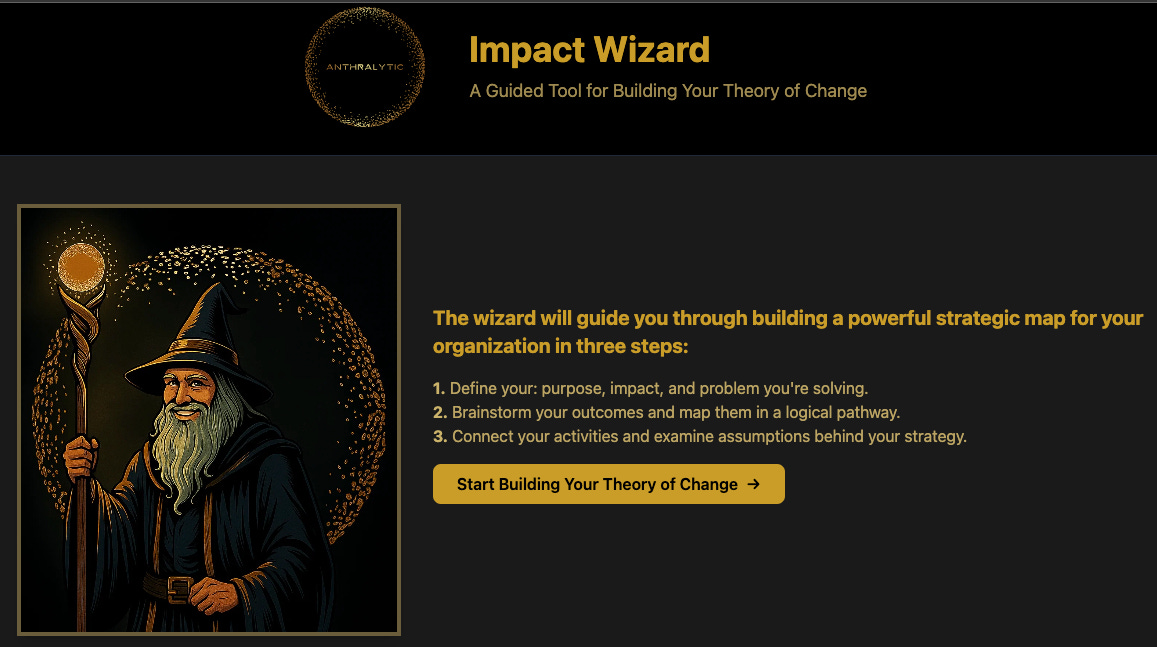
If you use Impact Wizard, we’d love to know how it went and receive any feedback you have!
Anthralytic helps mission-driven organizations cut through the jargon and build practical tools for strategy, evaluation, and impact. Human-led. AI-powered. Impact-driven.