

First, I want to be transparent—I am not an education expert. This post is from the perspective of a parent and a person who has incorporated AI into their everyday work. I’d love to hear your thoughts on these questions!

I see firsthand how students are already using ChatGPT (and it is mostly ChatGPT). Too often, kids are focused on completing the assignment. They start using it when they’re stuck but eventually it’s just easier to let ChatGPT do the work instead of using Gemini’s guided learning or Notebook LM to actually get help learning the material. Essentially students are just using it to cheat.
Part of the problem is cognitive offloading—when we let technology hold knowledge or perform thinking tasks we would otherwise do ourselves. Offloading can free up mental space for creativity, but does it also means students may shortcut the struggle that builds understanding? Probably. Kids aren’t learning the material if they’re simply asking AI to write their papers for them.
Add to that automation bias—our tendency to trust machine outputs without questioning them. Today’s world demands critical thinking more than ever. Will over-use of AI stunt the development of critical thinking skills for our young scholars? What is the ultimate cost of that down the road across the nation and the world?
These questions are why efforts like OpenAI’s SchoolAI caught my attention. As Nate Sanders, their Chief Experience Officer, put it: “We’ve done a lot of work to make AI not do things for you. If AI just gives the student the answer, we’ve failed—the point of teaching is to coach and to keep them engaged in the work.”
Unfortunately, most schools’ official response has been prohibition. But bans don’t work. You can’t roll back technology, and you can’t stop kids from experimenting.
Another challenge is that all around us we see our work changing as adults are leveraging AI in their work, improving outcomes and productivity (along with some downsides we’ve covered in previous posts). This raises a deeper question: What do students really need to learn right now? If the future of work looks different, should we still be preparing kids to write five-paragraph essays? Or should we be teaching them how to interrogate, contextualize, and improve on the answers AI gives them?
Now, with Microsoft, OpenAI, and Anthropic launching a massive AI Teacher Training Academy, we’re seeing an unprecedented level of investment to train hundreds of thousands of teachers. In my view, that raises both hope and caution.
✅ The Pros
Scale. No one else can move this fast—hundreds of thousands of teachers could gain AI fluency in just a few years (which is eons in AI years).
Relevance. Big companies know their tools best and can provide hands-on, practical training.
Urgency. Without outside push, most schools would keep stalling while students experiment unguided.
⚠️ The Cons
Stickiness. Training is often product onboarding in disguise—locking schools into specific platforms.
Dependency. Relying on corporate-led curricula risks narrowing pedagogy to match business models.
Trust. Companies aren’t neutral; their incentives may not fully align with student learning.
As a parent, I agree that training is essential—and companies may well be best placed to deliver it. But we should also be honest about what’s at stake: this is both about preparing students and expanding markets.
That leaves me with a final question I’d like to put to you: Who should be responsible for building AI literacy in schools—tech companies, teachers, government, or someone else entirely?
We’d love to hear what you think! Leave a comment, send us a message or join the chat!
At Anthralytic, we explore how AI and human judgment intersect—in classrooms, nonprofits, and beyond—so decisions serve learning and impact, not just technology.
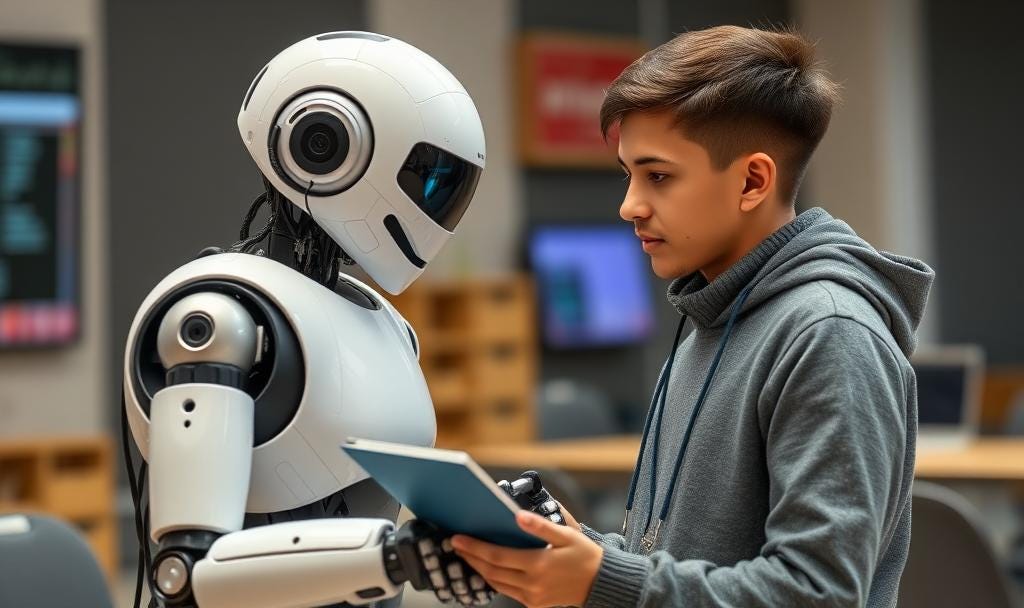
The CEO of schoolai.com seems to have it right: "If AI just gives the student the answer, we’ve failed—the point of teaching is to coach and to keep them engaged in the work."
There's no undo command for AI, it's not going away, and the only task we have as parents and educators is to live with it and continue to understand it. Unfortunately, collateral damage to outcomes is inevitable, as AI adoption is reaching new highs within k12 and higher ed -- and the answer is far too easy to procure without the requisite understanding. Yet it's incumbent on all involved (teachers, educators, and big tech) to figure out how the JOURNEY to the answer becomes the substrate on which student leverage AI, not the answer itself. It's a very challenging task, but in the end i think we'll be much better off with this technology than without.