

USAID is gone. On July 1, 2025, the agency officially ceased operations. More than 80 percent of its programs were terminated. The FBI now occupies its headquarters. Whatever you think about foreign aid, that is a staggering institutional collapse, and the human cost is measured in lives as well as livelihoods.
From an evaluation and social impact strategy perspective there are many things worth salvaging from the wreckage. This post is about one.
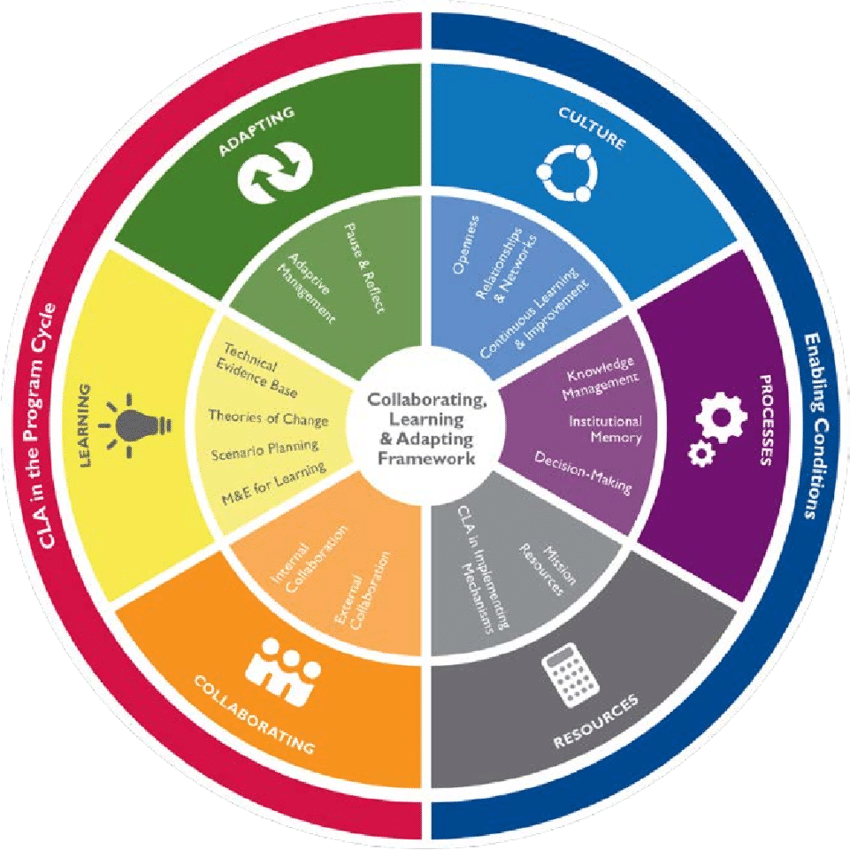
Before USAID became a political target, its Bureau for Policy, Planning and Learning developed something genuinely useful: a framework called Collaborating, Learning, and Adapting, or CLA. It was not flashy. It did not get much attention outside the international development world. But it was one of the clearest articulations I have seen of what it actually looks like when an organization decides to learn from its own work rather than just report on it.
And most of what made CLA valuable has nothing to do with billion-dollar budgets or country missions. It scales down. A ten-person nonprofit can use the core ideas just as effectively as a USAID mission in Uganda. Maybe more effectively, because smaller organizations have fewer layers between a question and a decision.
What CLA Actually Is
CLA is built on a simple premise: development programs work better when people collaborate intentionally, learn from what they are doing while they are doing it, and adapt based on what they find.
That sounds obvious. It is not. Most organizations treat learning as something that happens after the work is done, in an evaluation report that arrives too late to change anything. CLA says learning should be continuous, built into the work itself, not bolted on at the end.
The framework has two dimensions. The first is about integrating collaboration, learning, and adaptation into the program cycle, which means planning, designing, implementing, and assessing. The second is about enabling conditions: organizational culture, processes, and resources that make learning possible.
That second part is where most organizations fail. They say they value learning, but they do not budget time for it, do not create space for honest reflection, and do not reward people who admit something is not working. CLA made those enabling conditions explicit rather than aspirational.
What This Looks Like at a Smaller Scale
You do not need a maturity matrix or a card deck to apply these ideas (don’t ask). Here is what CLA looks like when you strip it down to what a smaller nonprofit can actually do.
Collaborating in the CLA sense means deliberately seeking out perspectives that challenge your assumptions while you can still do something about it.
Not networking. Not partner meetings where everyone reads updates from their laptops. It means asking your peer organizations what they are seeing before you finalize your program design. It means checking with the community you serve whether the problem you are solving is the problem they actually have.
For a small nonprofit, this might be as simple as a quarterly conversation with two or three organizations doing adjacent work. Not a formal coalition. Just a regular practice of comparing notes. What are you seeing? What changed? What did you try that did not work?
Hot tip: People feel much more comfortable telling you what they really think and feel in a less formal setting.
Learning means putting regular time on the calendar to think and talk about what is happening in real time.
USAID called these “pause and reflect” sessions. The name is better than most evaluation jargon because it describes exactly what needs to happen: you stop, you look at what the evidence is telling you, and you think about what it means before you move on. You decide together to pivot or persevere.
For a small organization, this could be a standing monthly meeting where the team looks at three questions: What did we expect to happen? What actually happened? What should we do differently? That is it. No elaborate data system required. Just honest conversation with a structure that keeps it from becoming either a gripe session or a performance review.
The key is that learning has to happen during the work, not after. An evaluation report that arrives six months after a program ends is useful for the field, maybe, but it is useless for the people who needed to adjust course in month three.
Adapting means actually changing what you do based on what you learned.
This is where most organizations get stuck. They pause, they reflect, they generate insights, and then they keep doing exactly what they were doing because the grant says so, because the board approved this plan, because changing course feels like admitting failure.
CLA was explicit about this: adaptation is not a sign of failure. It is a sign that you are paying attention. If your environment changed and you did not, that is the failure.
For smaller nonprofits, this often means having an honest conversation with your funder. Most funders are more open to adaptation than organizations assume, but the conversation has to happen proactively, not after the fact. “We learned something that suggests we should shift our approach” is a much easier conversation than “we did not do what we said we would do.”
The Enabling Conditions Matter More Than the Framework
The most important thing USAID got right with CLA was naming the conditions that make learning possible. You can have the best pause-and-reflect questions in the world, but if your organizational culture punishes honesty, nobody will answer them truthfully.
CLA identified several enabling conditions, but three matter most for smaller organizations.
First, a culture where it is safe to say “this is not working.” Not in theory. In practice. Does your executive director respond to bad news with curiosity or defensiveness? Does your board treat disappointing results as learning opportunities or as evidence that staff are underperforming? The answer to those questions determines whether any learning framework will function or whether it will just generate polite fictions.
Second, processes that make learning routine rather than exceptional. Learning should not require a special retreat or an outside consultant. It should be woven into your regular meetings, your reporting cycles, your supervision conversations. If learning only happens when someone schedules it, it will not happen often enough to matter.
Third, resources. This is the hardest one for small organizations. Learning takes time, and time is the scarcest resource in the social sector. CLA was explicit that organizations need to budget for learning, not just for doing. That might mean protecting two hours a month for reflection. It might mean building learning questions into your existing data collection rather than adding a separate evaluation layer. But it has to be intentional, because the urgent will always crowd out the important unless you protect the space.
What USAID Got Wrong
CLA was not perfect. It was developed inside a massive bureaucracy, and it sometimes showed. The maturity matrix had five stages across sixteen subcomponents, which is useful for a mission with a dedicated learning advisor and less useful for an organization where the same person writes the grants, manages the programs, and takes out the recycling.
More fundamentally, CLA was still a framework designed to improve programming within a system that was accountable primarily to funders, not to communities. The “stakeholder engagement” component was real, but the power dynamics were baked in. Communities were consulted. They were not in charge.
And CLA could become performative. I have seen organizations check every box on a CLA maturity assessment and still operate as if learning were a compliance exercise. The framework cannot fix an institution that does not actually want to learn. No framework can.
Why This Matters Now
USAID is gone, but the evaluation infrastructure it supported, the learning practices it developed, the institutional knowledge it accumulated over sixty years, that does not have to disappear with it.
CLA was one of the agency’s better ideas. It was practical, it was grounded in how organizations actually work, and it was honest about the conditions that make learning possible. The international development community built a significant body of practice around it.
Smaller nonprofits in the domestic social sector can inherit those ideas without inheriting the bureaucracy. The core insight is transferable: if you want to get better at your work, you need to collaborate with the right people, create space to learn from what you are doing, and be willing to change based on what you find. And you need an organizational culture that makes all three of those things possible.
That is not a USAID idea. It is a good idea. And good ideas deserve to outlive the institutions that housed them.
Anthralytic is a strategy and evaluation studio that helps mission-driven teams clarify and amplify their impact. If you make decisions about resources in the social sector, whether you call yourself an evaluator or not, this newsletter is for you
.