

The argument for gutting USAID was straightforward: waste, opacity, a slush fund with no accountability. Elon Musk wanted photographic proof that the agency did anything at all. Marco Rubio called it a “failed institution,” which is worth pausing on: this is the same Marco Rubio who, during his 2016 presidential campaign, had cited USAID’s HIV work in Africa as a model of American generosity worth defending. DOGE, the accountability project, was going to clean it up.
Here is what was actually there when they walked in.
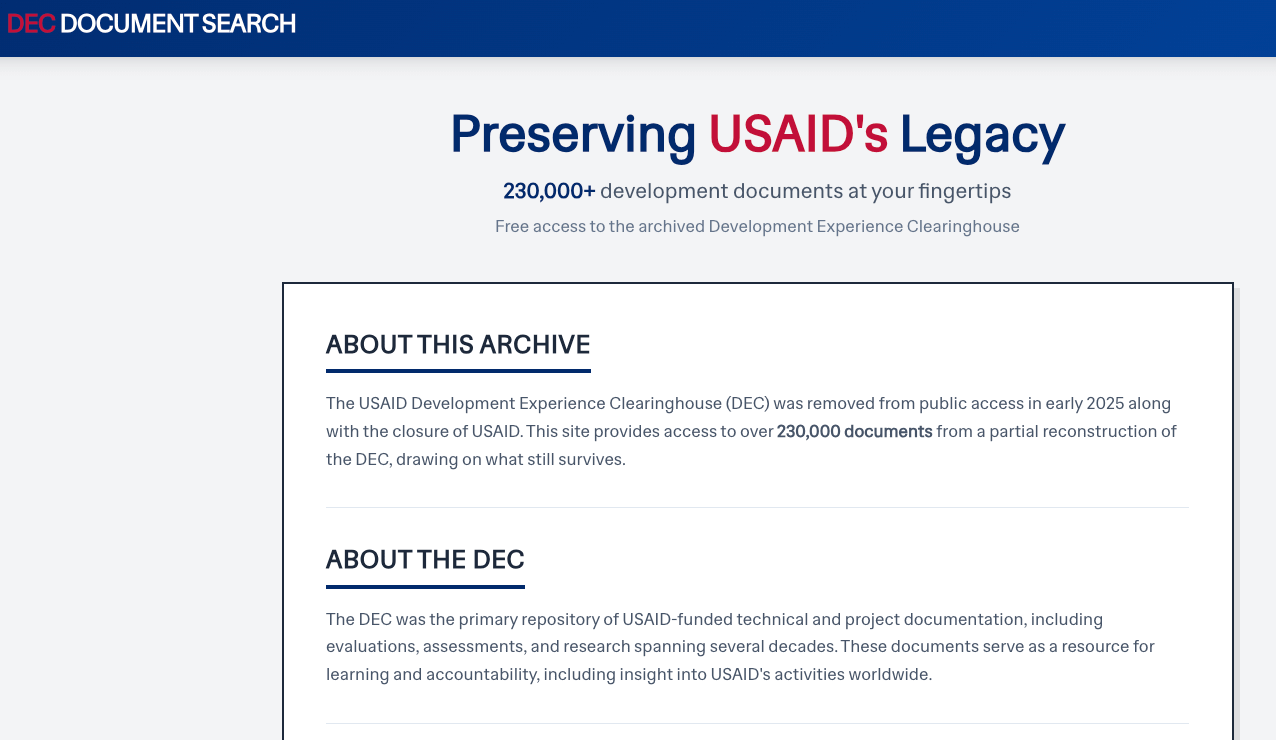
Every USAID contract required an Activity Monitoring, Evaluation, and Learning plan. ADS 201, the agency’s evaluation policy, set rigorous standards for how evaluations were designed, conducted, and reported. Evaluators were required to disclose conflicts of interest. Results had to be published. And the agency maintained three separate public repositories: the Development Experience Clearinghouse1, which held tens of thousands of finished evaluations and reports; the Development Data Library, which required implementing partners to submit underlying datasets within 30 days of use; and ForeignAssistance.gov, which showed the public exactly where the money went and what it produced. That site had just won the inaugural Federal Data Excellence Award, given by the Partnership for Public Service and USAFacts. It is unclear whether anyone at DOGE knew the DEC, the DDL, or ADS 201 existed before they took the website down.
I worked extensively with ADS 201 requirements over the years. They were rigorous. Sometimes to an annoying degree. But that rigor existed because the stakes were high, the money was public, and the people depending on these programs deserved a system that took accountability seriously.
When the administration took down the USAID website, it did not remove one thing, it removed a whole ecosystem. The finished reports. The underlying data. The spending records. The institutional memory of what had worked, what had not, and under what conditions. All of it, gone or degraded overnight. The Pentagon, for context, has never passed a clean audit. Its FY2024 audit resulted in a disclaimer of opinion, meaning auditors could not assess its financial statements at all. DOGE did not go after the Pentagon. It went after the agency that had just won an award for excellence.
USAID was not without legitimate critique. The agency sometimes got flack because the model of aid delivery could create dependency, routing money through large US contractors rather than building local capacity. That critique had real substance. But under Samantha Power, USAID was actively working to change exactly that. Locally led development was a policy direction, with concrete targets for channeling more funding directly to local organizations and shifting ownership of findings to the communities being served. The work was incomplete. The critics were not entirely wrong. But the administration destroyed the institution at the moment it was trying to correct the very thing they claimed to object to.
Bearing witness is one of the three tenets of the Zen Peacemakers: Not Knowing, Bearing Witness, Taking Action. Bearing witness means staying present to what is actually happening: not looking away, not abstracting suffering into data before you have let it land, not managing your distance so carefully that you stop seeing. It is the precondition for any action grounded in truth rather than ideology. I wrote about this earlier this year in the context of Minneapolis, filming from my window as ICE took someone from my street. That was bearing witness. Not because it fixed anything. Because something in me said: this cannot happen without someone seeing it. The same instinct drives the researchers who have been counting the dead since USAID was dismantled. They are not doing this because the data is easy to collect. They are doing it because the alternative is to let the official silence stand.
A year later, here are the numbers. ImpactCounter, a real-time mortality tracking platform built by Boston University epidemiologist Brooke Nichols, estimates more than 762,000 deaths in the first year since the cuts, including more than 500,000 children. That includes 158,000 adults and 16,000 children from PEPFAR cuts alone, plus 164,000 children from pneumonia, 125,000 from diarrhea, 70,000 from malaria, and 48,000 from tuberculosis. The Center for Global Development puts annual deaths from the spending decline at between 500,000 and one million. The Lancet now projects more than 14 million additional deaths by 2030 if current trends continue, including more than 4.5 million children under five.
Atul Gawande, who led global health at USAID under the Biden administration, traveled to Kenya and documented what he found: a 14-year-old orphan dead from lack of HIV medication, a mother staying in a clinic with her malnourished daughter while her other children went days without eating at home. He called it “public man-made death.”
Marco Rubio testified before Congress that no one has died.
This is the evaluator’s dilemma made visible to everyone. Evidence takes time. Death is immediate. Political actors will use the gap between them to deny what is happening. A full accounting may not be possible until 2027, when UN mortality statistics catch up. In the meantime, some people refused to stop counting.
Nichols built ImpactCounter in four days, launching the PEPFAR tracker before the ink was dry on the stop-work orders. PhD students and postdocs at Boston University calculated excess mortality across every disease USAID had targeted. Accountability Lab and Humentum launched the Global Aid Freeze Tracker in February 2025 specifically because no centralized reporting on the human and economic impacts of the freeze existed. The Center for Global Development has continued to update its mortality models as new data comes in. Gawande wrote the New Yorker piece, co-produced “Rovina’s Choice,” and kept talking.
This past Sunday, John Oliver spent 34 minutes on Last Week Tonight naming what happened, showing who died, and pointing out that Trump’s replacement strategy, the “America First Global Health Strategy,” is a promise built on the rubble of the institutional scaffolding that would have been required to deliver it. Oliver covered much of the same ground this piece covers, and that is worth noting: the story is now reaching audiences well beyond the evaluation field. A late-night comedian is doing the accountability work that official channels abandoned.
These are people who stayed present when it would have been easier to move on. They built the parallel record. They kept the count visible so the official silence could not stand unopposed. That is the third tenet: taking action from awareness. Not from ideology. Not from a predetermined conclusion. From what they actually saw.
The accountability system was not missing. It was dismantled. And the people who dismantled it did so without any of the transparency they claimed to demand, without the evaluations they claimed to require, without any of the evidence-based review they used as justification. The evaluators are still counting. That much, at least, is holding.
Resources worth your time:
ImpactCounter by Brooke Nichols, Boston University
Global Aid Freeze Tracker by Accountability Lab and Humentum
Update on Lives Lost from USAID Cuts by Center for Global Development
The Shutdown of U.S.A.I.D. Has Already Killed Hundreds of Thousands by Atul Gawande, The New Yorker
Rovina’s Choice documentary, The New Yorker
USAID: Last Week Tonight with John Oliver HBO

Anthralytic is a strategy and evaluation studio helping mission-driven teams clarify and amplify their impact. If you know someone who makes decisions about resources in the social sector, whether they call themselves an evaluator or not, this newsletter is for them.
I missed that John Oliver episode, will make sure to watch it!