This piece reflects publicly available information as of September 5, 2026. The proposal and the city’s regulatory process are still evolving.
I want to be honest and transparent about my own position: I use AI. Probably heavily.
I use it to make my work more efficient and effective and, I hope, to produce work that benefits people. Like most of us, I also depend on the internet throughout my work and daily life. I store documents in the cloud. I stream music and video. I buy things online. I search, scroll, message and share. I try to make sustainable choices, but our work and lives have been organized around digital systems in ways that make simply opting out extraordinarily difficult.
All of that does happen in the cloud. But the cloud is not weightless or placeless. It is a service built on physical infrastructure.
Every prompt, search, shared document and streamed video is processed or stored somewhere in a physical building filled with servers, cooling equipment, electrical connections and backup generators. The internet has a body. It takes up land. It draws power. It produces heat. Sometimes it consumes water. It lives somewhere.
Now, someone wants it to live in my backyard.
Legacy Investing is an Arlington, Virginia-based real estate investment and development firm with a dedicated data-center business, Legacy Data Centers. It develops and repositions properties for enterprise, cloud and AI computing tenants. In this proposal, Legacy is the prospective buyer and developer, not the still-unidentified company that would ultimately occupy the facility and run the servers. That distinction matters because the developer can make commitments about the building, but many of the facility’s eventual energy and environmental impacts will depend on the tenant and its computing workloads.
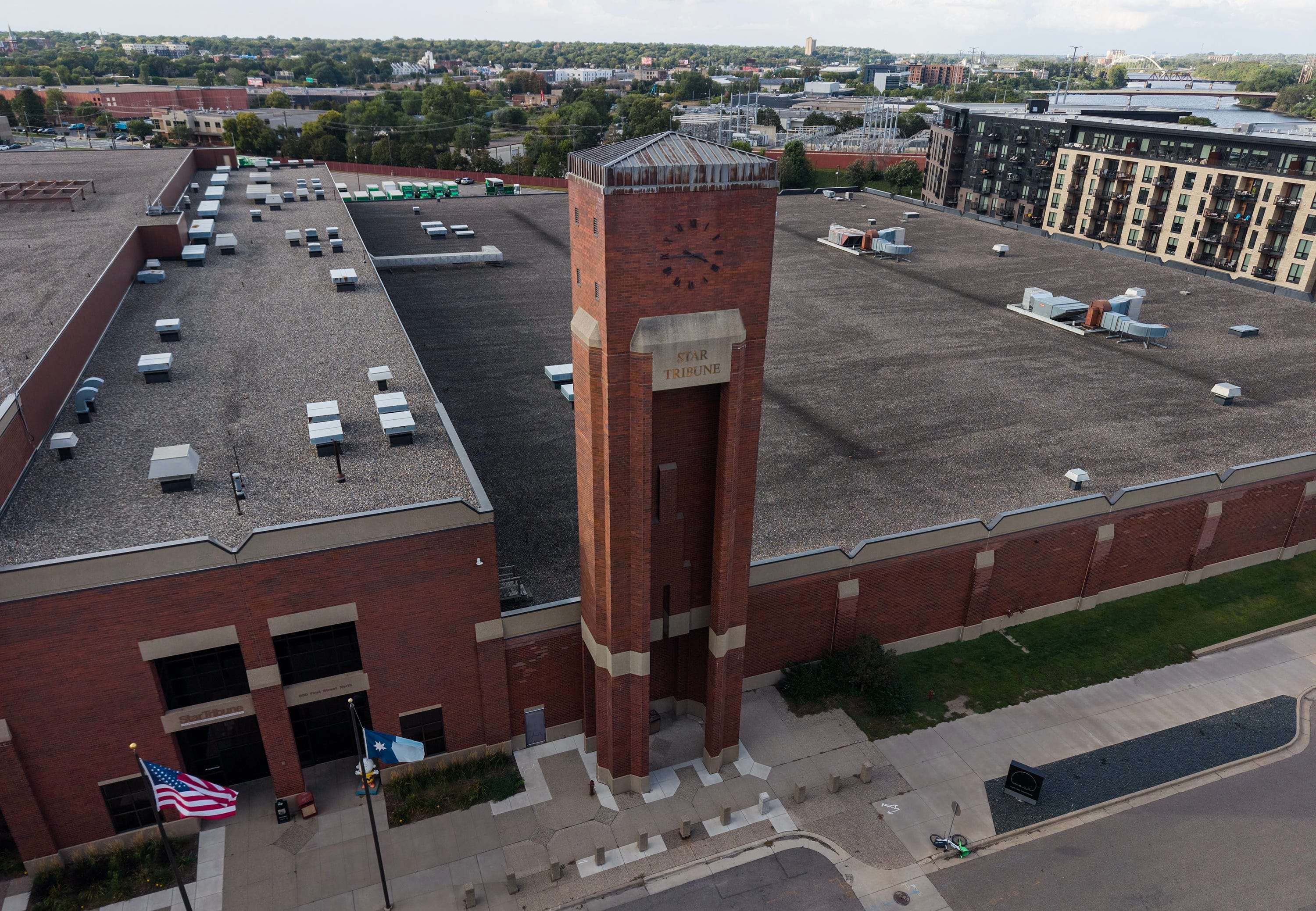
Legacy has entered into an agreement to purchase the former Minnesota Star Tribune printing facility at 800 North First Street, a roughly 13-acre site in Minneapolis’s North Loop. The company wants to convert the enormous press building into a data center and describes the project as part of a broader mixed-use redevelopment.
The proposed data center would be “around 20 megawatts initially,” according to an interview the developer gave the North Loop Neighborhood Association.
That sentence contains a word doing a lot of work: initially.
Twenty megawatts of continuous demand would equal about 175 gigawatt-hours of electricity in a year. That is not a forecast of what the facility will actually consume; we do not yet know whether the 20 MW refers to the servers, the whole building, the interconnection capacity or only a first phase. But that is exactly why the qualification matters. “Initially 20 MW” could eventually mean 30 MW, 50 MW or something larger unless the approval establishes a real ceiling.
I have written before about AI’s environmental footprint, including the possibility that AI could help reduce its own energy and resource use. At the time, I was writing about a global system. This proposal has forced me to ask what those arguments mean at the scale of a neighborhood. My neighborhood.
It is easy to oppose a data center in the abstract. It is also easy to praise one in a press release. It is much harder to decide whether this particular facility, on this particular site, under these particular conditions, would produce more public value than public cost.
That is the work we need to do now.
Watch the Meeting
Before deciding what you think, I recommend watching the recording of the August 19 North Loop Planning + Zoning meeting.
The meeting is important partly because of what did not happen. The committee did not endorse the proposal. It did not reject it either. It took no action because Legacy’s representatives were prepared to discuss data centers generally but could not yet provide the site-specific information committee members wanted about electricity, water, noise and other impacts. The committee requested more time.
That distinction matters. Unanswered questions are not evidence that a project is harmful. They are also not a basis for approving it.
Legacy has offered a plausible case for the site. Printing plants have strong floors, high ceilings, large open spaces and substantial infrastructure. The company says it expects to use closed-loop and air-cooling technology with very little water. It says generators can be placed inside the building and acoustically managed. It says existing power infrastructure can serve the project without adding new strain to the grid. It says other conversions of the press building would be financially difficult and that surrounding parcels could support community-oriented or mixed uses.
Each of those statements could be true.
But at the meeting, they remained statements. The engineering plans, utility analysis, enforceable limits and financial commitments needed to test them were not available. We were being asked to evaluate the shape of a project by looking at the blank spaces around it.
The Two Easy Answers
The first easy answer is: No way.
Data centers use too much electricity. They can consume water, produce noise and generator emissions, create relatively few permanent jobs, receive public subsidies and lock valuable land into a highly specialized use. Put the words “AI data center” next to a neighborhood and opposition now arrives almost automatically.
The second easy answer is: Why would we turn this down?
The building is vacant. Its former use is gone. A data center could restore taxable value, generate construction activity, reuse an industrial structure and contribute electricity franchise fees to the city. Minneapolis has a budget problem and a weakened commercial tax base. Why refuse an investor willing to put an obsolete building back to work?
Mayor Jacob Frey is trying to occupy the space between those positions. He has said data centers need regulation to protect livability, health and safety, but also argues they could help lower the tax burden on everyone else. He does not want a data center to be the only use on the property; he wants something the neighborhood can use too, such as restaurant or event space.
That argument requires some context. Frey is not an outside observer of the city’s tax burden. Under Minneapolis’s current government structure, city departments report to the mayor. The mayor proposes the budget, the City Council amends and adopts it, and the mayor approves the result. Frey therefore did not create the city’s fiscal problem alone, but his administration has helped make the spending, staffing and budgeting decisions that produced it.
For 2027, Frey has proposed an 11.3 percent increase in the city’s property-tax levy and the elimination of roughly 100 positions to address a budget problem of more than $60 million. The gap reflects inflation, rising labor and operating costs, the end of federal pandemic relief, declining downtown property values and repeatedly underbudgeted police overtime. Operation Metro Surge added to the pressure, costing the city more than $6 million in one month, but it did not create the entire structural problem.
Frey did not create the tax burden alone: the mayor proposes the budget and oversees city departments, while the City Council amends and adopts it. But he is not an outside observer either. City leaders helped create the imbalance residents are now being asked to correct. That makes the prospect of new tax revenue relevant, but the city’s need for money does not establish that this particular project provides a net public benefit.
How much net tax revenue would this project produce after exemptions and public costs? Would the surrounding development actually be built? Who would pay for any grid upgrades? What happens if the tenant leaves? What does “minimal” water use mean in gallons, during both average operations and the hottest week of the year?
The economic benefit cannot simply be assumed because the building would become more valuable. The environmental harm cannot simply be assumed because it would contain servers. Both have to be demonstrated.
We Cannot Say No to All of Them
This is where my own AI use matters.
It would be incoherent for me to demand the benefits of AI and the internet while insisting that every community refuse the infrastructure that makes them possible. Even people who never touch ChatGPT depend on data centers for medical records, banking, emergency services, government systems, logistics, communications and ordinary websites.
We need data centers.
But needing data centers collectively is not the same as needing every proposed data center, at every proposed size, in every proposed location, on whatever terms its developer offers.
Necessity should give the public more bargaining power, not less. If data centers are becoming essential infrastructure, we should plan them with the seriousness we apply to other essential infrastructure. We should decide where they fit, what capacity a place can support, who pays for the supporting systems and which obligations will remain after the current developer or tenant is gone.
The question is not whether data centers should exist.
The question is: Where should they go, where should they not go, and what does a responsible yes require?
Where Should Data Centers Go?
There is no impact-free location. Moving a data center out of an affluent urban neighborhood does not make its power, water and land requirements disappear. It may only move them to a rural community with a smaller utility rate base, a stressed aquifer, valuable farmland or less political power.
“Put it somewhere else” is not an infrastructure policy.
At the same time, not every empty building or industrial parcel is a good data-center site. Research from the U.S. Department of Energy’s Lawrence Berkeley National Laboratory shows that the same digital work can carry very different water and carbon consequences depending on where and how it is performed. Location is not a secondary question to be addressed after a deal is announced. It is part of the environmental technology of the facility.
I’ve been going down a rabbit hole the past day reading about this and I’ve found that a good site begins with several things, the first being grid fit. It has demonstrable electrical capacity or a credible plan for adding capacity without shifting upgrade costs and stranded assets to households and other businesses. The facility can reduce or curtail demand during grid stress, add genuinely new clean generation and match its consumption to clean power in the place and hours where it operates, rather than just buying annual renewable credits from somewhere else.
It also has water fit. The cooling design matches the local watershed and climate. It uses little or no potable water where supplies are constrained, and its water claims include both direct cooling and the water associated with electricity generation. A facility that is efficient in carbon terms can still be badly located in water terms. There is no single sustainability number that resolves every tradeoff.
Then there is land fit. Existing industrial buildings, brownfields and retired power sites may offer reusable structures, transmission equipment and lower-conflict land. But “industrial” is not a magic word. Cities should still ask what else the site could become and what the community gives up by dedicating it to servers for decades.
There is neighborhood fit. Cooling equipment, transformers and generators have to coexist with the people already there. Distance, building design and enforceable property-line limits matter. A facility should not go where it can meet its operational needs only by asking nearby residents, schools or hospitals to absorb continuous noise or episodic pollution.
Finally, there is governance fit. A responsible site is in a jurisdiction willing and able to require public data, enforce limits, inspect operations and respond when the facility changes. A community should never be selected because its rules are weak or because its residents have less capacity to resist.
The simplest version is this:
A data center should not go anywhere it can operate only by externalizing its costs.
It should not depend on residents financing its electrical infrastructure, another community supplying its clean energy, a stressed watershed absorbing its cooling demand, or promises of future development substituting for binding commitments now.
Does the North Loop Site Fit?
The honest answer is that it has some characteristics of a good site and several unresolved warning signs.
Reusing the former printing plant could be a real benefit. It is an unusually large, specialized industrial building that may be difficult to convert to housing or ordinary commercial space. Preserving and adapting it may avoid some of the material and carbon costs of demolition and new construction. If existing electrical and structural infrastructure can genuinely be reused, that matters too.
The site is also not an isolated industrial campus. It sits within the North Loop, a growing neighborhood where people live, walk, work, eat and gather. The property is large enough that its use will shape this part of Minneapolis for decades. That raises the standard for noise control, street-level activity, urban design and the promised mixed-use component.
Most importantly, the core claims have not yet been substantiated publicly.
“Existing infrastructure” is not the same as a completed utility study showing available capacity, required upgrades, cost allocation and effects on reliability. “Closed-loop cooling” is not a water budget. “Generators inside” is not a noise and emissions analysis. “Mixed use” is not a construction schedule, financing plan or recorded obligation.
And “initially 20 MW” is not a maximum.
Minnesota’s Environmental Quality Board says connected and phased actions should be considered together in environmental review, including expansions that are planned or reasonably likely. Minneapolis should evaluate the facility the building and infrastructure are capable of supporting, not only the first equipment installed.
That question is especially urgent because the city is in the middle of rewriting its data-center rules. Its preliminary recommendations would require a conditional-use permit, disclosure of projected water and electricity use, evidence of utility coordination, restrictions on equipment placement and a rule that new downtown data centers cannot be the only principal use on a property.
But according to the timeline provided by the North Loop Neighborhood Association, this application may be decided under the current, less specific rules if it is deemed complete before the new regulations take effect. If that happens, the conditions attached to this particular approval become even more important.
Can AI Reduce the Footprint of AI?
Here is the hopeful part: yes, it can.
Machine learning can analyze temperatures, pump speeds, weather, server loads and thousands of sensor readings to operate cooling systems more efficiently than static rules. In 2016, Google reported that its DeepMind system reduced cooling energy by as much as 40 percent, equivalent to about a 15 percent reduction in the facility’s overall non-computing energy overhead.
That distinction is important. It was not a 40 percent reduction in the total electricity used by the data center. It was a large improvement in one part of the system.
AI can also forecast equipment failure, consolidate workloads onto fewer machines, schedule flexible computing for cleaner hours and coordinate increasingly complex combinations of air and liquid cooling. A 2025 systematic review in Applied Energy identified 65 studies using reinforcement learning to improve cooling, workload scheduling, resource allocation and other data-center operations. The body of research is promising, although much of it still depends on models, simulations or facility-specific experiments rather than transparent, long-term public results.
Cooling technology itself is improving. A 2025 life-cycle assessment published in Nature found that advanced cold-plate and immersion systems could reduce energy demand, greenhouse-gas emissions and blue-water consumption compared with conventional air cooling. But the study also illustrates why we need life-cycle analysis: a technology that looks efficient at the server can carry different material, chemical or end-of-life consequences elsewhere.
So yes, AI can help shrink a data center’s footprint.
What it cannot do is make unlimited growth sustainable.
The International Energy Agency reported in 2026 that electricity used per AI task is falling rapidly, while total data-center electricity demand is still on track to double by 2030. Efficiency makes each unit of computing cheaper. Cheaper computing encourages more use. AI agents may perform hundreds or thousands of operations where a person once made one request. The denominator improves while the total keeps rising.
This is why an efficiency ratio is not an environmental limit. If both figures describe total facility demand, a data center operating at 50 MW draws exactly 30 MW more power than one operating at 20 MW, or two and a half times as much. If both ran continuously at those levels for a year, the difference would be 262.8 gigawatt-hours. The larger facility may perform more computations per unit of electricity. It still consumes more electricity overall.
It is also why we need to know who controls what. The building operator controls much of the cooling and physical infrastructure. The tenant controls the chips, models and workload scheduling. The utility controls much of the power supply. With no tenant identified, Legacy cannot yet tell the public whether workloads will shift to cleaner hours, which hardware will be installed, how heavily it will run or whether AI will actually be used to optimize operations.
The right questions are concrete:
Will this facility use AI-managed cooling, or is that merely possible in the industry?
What Power Usage Effectiveness and Water Usage Effectiveness will it guarantee?
Will it report total electricity and water consumption, not just efficiency ratios?
Can its workloads respond to grid stress?
Will its clean-energy purchases add power to the local grid and match consumption hourly?
Who verifies the results?
“AI can reduce the footprint” is a reason to set a higher performance standard. It is not a reason to assume the standard will be met.
Follow the Power, the Water and the Money
The immediate effects of a data center can be measured. Minneapolis should insist on measuring them before and after approval.
For power, we need the expected average and peak demand, the hard maximum demand, the proposed ramp-up schedule and the upgrades necessary to serve it. Minnesota’s Public Utilities Commission describes its role as protecting reliability and preventing the costs of serving large data centers from being shifted to other customers. But aggregate promises are not enough. The public needs to know how those protections apply to this project and what happens if the customer leaves before the infrastructure is paid off.
For water, we need annual and peak-day consumption, the source, the cooling technology and the conditions under which the system might change. A design that uses little water today should not be allowed to add evaporative cooling later without new review.
For noise and air, we need the number, size and location of generators; their fuel; their testing schedule; their expected operating hours; their exhaust controls; and measured noise limits at the property line. Equipment being indoors may help. It does not remove the need for evidence.
For money, we need a net fiscal analysis rather than a gross property-value claim. A data center may contribute substantial property taxes, electricity franchise fees and construction spending. It may also receive exemptions and create far fewer permanent jobs after construction ends.
Minnesota’s own evaluation of the state data-center equipment tax exemption is a useful warning against assuming that every large capital investment pays for itself. Looking across the state’s experience rather than this particular project, the report estimated approximately $0.98 in value-added impact for every dollar of forgone revenue, compared with $1.19 if the state collected and spent that dollar on public services. The report also found that the largest employment effects occur during the two-to-three-year construction period.
That does not prove the North Loop project is uneconomic. It proves that the benefit has to be calculated rather than declared.
And then there is the hardest cost to quantify: what this site will not become. A data center might be the most financially feasible reuse of the printing building. It does not follow that it is the best use of the entire property. The surrounding parcels, the street edge and the connection between the neighborhood and the river-adjacent industrial district all carry opportunity costs. “Mixed use someday” is not enough to resolve them.
Promises Need Longer Lives Than Press Releases
The facility Minneapolis approves today may not be the facility operating ten years from now.
The initial 20 MW may become 30 or 50. A cloud tenant may be replaced by a more energy-intensive AI tenant. A dry-cooled facility may add evaporative cooling. Promised housing, retail, public space or event uses may be delayed after the data center is operating. The property may be sold. Improved efficiency may lead to greater utilization. Grid investments may become stranded if the tenant leaves. A capital-intensive data-center conversion may determine the site’s character long after today’s officials and developers have moved on.
A responsible yes has to mitigate every one of those possibilities.
That means a hard cap on both total facility demand and IT load, with a new public review before either increases. It means a binding water ceiling and a prohibition on materially changing the cooling system without approval. It means publicly enforceable noise, generator and emissions limits. It means treating a major change in tenant or workload as a potential change in impact, not merely a private leasing decision.
If mixed-use development is part of the public-benefit case, its milestones should be tied to the data center’s power ramp or occupancy. The profitable component should not be completed first while the community component remains perpetually conceptual. Performance bonds or other financial security should back the promise.
The obligations should run with the land so they survive a sale. The utility agreement should protect other customers against upgrade and stranded costs. The project should carry decommissioning security so the public is not left with specialized infrastructure and an empty shell if the market changes.
And the facility should report what it actually uses, not only what it projected in its application. At minimum, annual public reporting should cover electricity, peak demand, water, carbon intensity, generator hours and fuel, property-line noise, efficiency metrics, tax payments, exemptions and progress on the mixed-use commitments. Independent audits should verify the numbers.
Some commercially sensitive information can remain private. Aggregate environmental performance cannot. A community cannot enforce a promise it is not allowed to measure.
My Answer, For Now
I am not asking Minneapolis to reject the infrastructure that makes my own work possible.
I am asking the city to decide where that infrastructure belongs and under what conditions, using evidence rather than fear or promises. This site may prove suitable. Reusing the press building may be smarter than demolishing it. A carefully designed data center may add revenue without imposing unacceptable costs. AI may help make it meaningfully more efficient.
But may is not the same as will.
Based on the information available now, I do not think there is enough evidence to approve the proposal. I also do not think there is enough evidence to declare that no responsible version of it could work.
Before a yes, Minneapolis should have:
A complete site-specific power, water, cooling, noise and generator plan.
Independent confirmation of grid capacity, upgrade costs and ratepayer protections.
A hard maximum size, with reasonably foreseeable expansion reviewed as part of the project.
A net fiscal analysis that accounts for incentives, public costs, jobs and alternative uses.
Binding deadlines and financial guarantees for the promised mixed-use development.
Actual public performance reporting and independent verification.
Conditions that survive a tenant change, cooling change, ownership change or closure.
If the developer can meet those conditions, the conversation should continue. If it cannot, Minneapolis should say no. Not because data centers are categorically bad, but because this one would be asking the public to accept risks the applicant is unwilling to measure or carry.
My use of AI does not disqualify me from asking these questions. It implicates me in them.
We do not get the cloud without the ground beneath it. We do not get frictionless digital services without physical costs landing in real communities. The answer cannot be to hide those costs somewhere with fewer resources or less power to object. It also cannot be to approve whatever arrives because the internet has become indispensable.
We need to learn how to say yes well.
“No data centers anywhere” is not a serious answer to a society that depends on them. “Trust us” is not a serious answer to the communities being asked to host them.
The work lies between those positions: identifying the places where the costs are lowest, the public benefits are real and the remaining risks can be bound tightly enough to survive the next expansion, the next tenant and the next sale.
We cannot say no to every data center.
We cannot say yes to a blank check.
Right now, Minneapolis should ask Legacy to come back with the meter, the model and the commitments, then refuse to call it a yes until all three are real.
Anthralytic examines AI, data, sustainability and the human consequences of technological change. I look beyond both hype and reflexive rejection to ask what the evidence actually shows, who benefits, who bears the costs and what responsible progress could look like. Subscribe to join me in making sense of the systems shaping our lives.