


You’re in a community meeting. Someone points to attendance numbers. “Looks good,” someone says. The room moves on. But no one asks why the people who didn’t come never showed up.
And just like that, a massive opportunity is missed. Were there few parents because you didn’t provide childcare? Did youth not show because of an event you didn’t know about? You may never know because no one asked the question.
In the mission-driven space, we work too hard—and the stakes are too high—for surface-level conversations. Yet we often accept generic “C-” questions because they’re safe. They keep meetings moving and don’t rock the boat. They also keep us from learning anything new.
Garbage in, garbage out. The quality of your insight is only as good as the question you asked to get there.
Why We Settle for Safe Questions
Let’s be real: asking an “A+” question can feel risky and sometimes it can actually be risky.
It might suggest the current strategy isn’t working.
It might reveal that no one has the answer.
It might make junior staff nervous.
It might get shut down in a hierarchical culture.
This is one reason consultants get hired—not because we see something others can’t, but because we can say what insiders can’t. We’re allowed to ask the “emperor has no clothes” questions.
But here’s the thing: anyone can learn this skill. And organizations that get good at asking better questions—and creating a culture where brave questions are commended—unlock better results.
From C- to A+: The 3-Filter Question Flip
Here’s how to upgrade your question from “meh” to meaningful using three simple filters:
The Utility Filter
Who is this question for, and what specific decision will the answer help them make? Is now the right time to ask it? A question is only as good as its usefulness to a specific person at a specific time.
The Context Filter
What are the power dynamics and level of psychological safety in the room? An A+ question in a private brainstorming session might be a D- in a tense board meeting if it can't be answered honestly.
The Intention Filter
What is your goal? Are you trying to hold someone accountable (did you do it?), facilitate learning (what did we discover?), or provoke new thinking (what if we are wrong?)? Clarity of intent shapes the question. (P.S. If you’re holding someone accountable, circle back to the question of psychological safety.)
AI Can Level Up Your Game With the Right Question (AKA prompt)
In a world where we’re drowning in dashboards, survey data, transcripts, and funder reports, your real advantage isn’t having more data—it’s knowing what to do with it.
That’s where AI comes in.
Not as a crystal ball, and definitely not as a replacement for human insight. But as a thinking partner that can help surface patterns, synthesize findings, and scale your learning process—if you start with the right question.
Here’s the catch: AI only gives good answers to good questions. If your prompt is vague, you’ll get noise. If your prompt is strategic, you’ll get gold.
So what makes a good AI prompt?
The same thing that makes a good evaluation question:
It’s clear about the outcome you care about
It’s specific about the audience or user
It respects context (like tone, power dynamics, or constraints)
For example, instead of asking:
“Did the training work?”
Ask something like:
“Act as an evaluator. Review survey data and interview transcripts to identify what helped participants apply their new skills on the job—and what barriers they faced. Give 3 concrete recommendations for future trainings.”
That’s the difference between using AI as a shortcut... and using it as a multiplier.
Whether you’re building a theory of change, analyzing community feedback, or planning your next strategic retreat, pairing a strong question with the right AI prompt can save hours—and surface insights you might have missed.
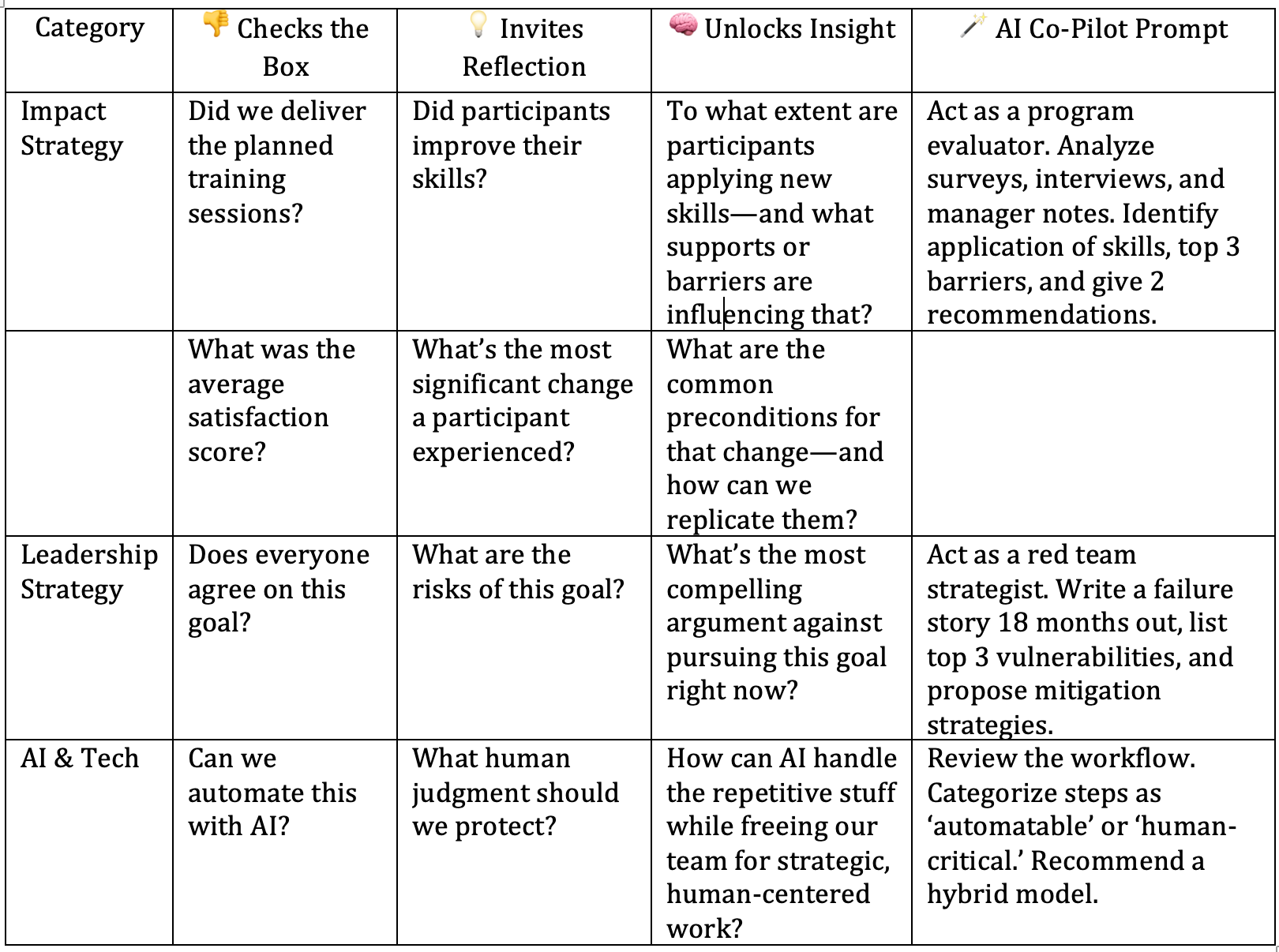
From Standard to Strategic: A Mini Playbook
This playbook shows how to level up your questions—and use AI to do the heavy lifting once you’ve framed the question right.
Your Turn: The Question Flip Challenge
This isn’t just about better meetings—it’s about better outcomes for your mission.
Here’s your move:
Take one “meh” question from your next agenda and flip it using the three filters.
Write it down.
Say it in the meeting.
Watch what happens.
Then come back here and tell us about it in the comments.
Let’s make this real.
Anthralytic helps mission-driven organizations ask smarter questions, use data more meaningfully, and unlock better impact. We blend human-centered strategy with practical tools—including AI—to make reflection, learning, and decision-making easier and more actionable. Follow us here or reach out to collaborate on making insight part of your everyday work.