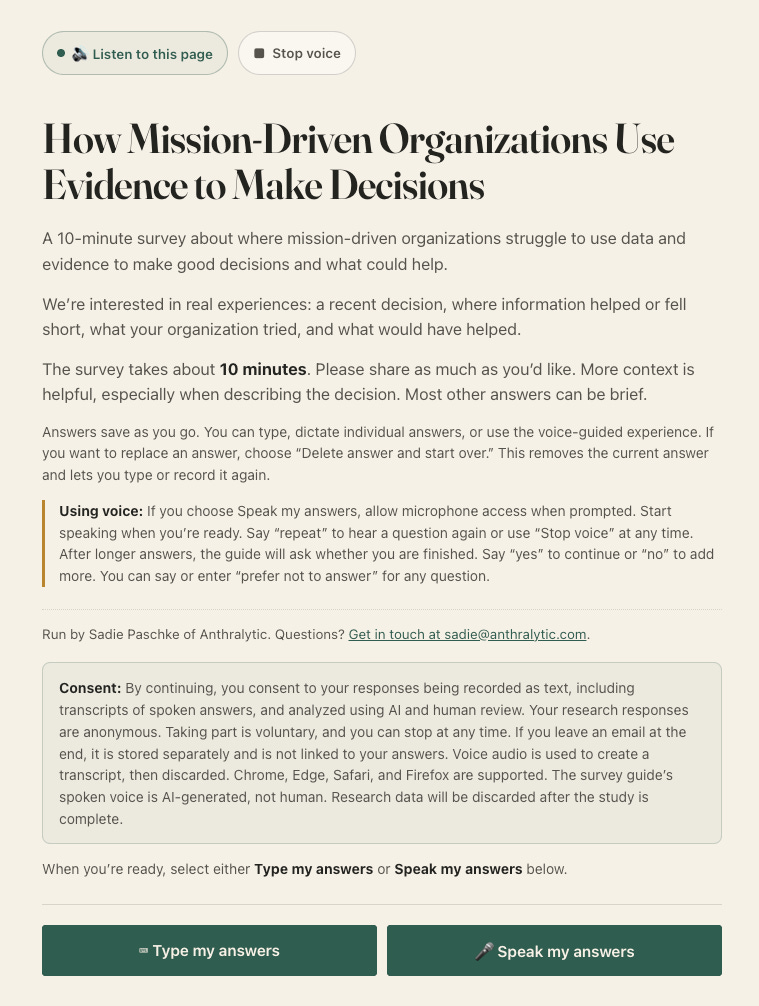
Mission-driven organizations make important decisions every day. Even when people want to use evidence, the right information may be hard to find, interpret, or trust.
I am conducting a short research project to understand where this process breaks down and what could help.
I also designed the survey a little differently. You can answer by typing, or you can let an AI-generated voice guide you through it. The survey reads each question aloud, listens to your spoken answer, and creates a transcript. It feels more like a short research conversation than a standard form. I have not seen many surveys work this way, and I would love for you to check it out.
What I want to learn
I want to hear about a real decision that needed data or evidence:
● What were you trying to decide?
● What information did you have or need?
● What made the process difficult?
● What did you ultimately do?
● What has your organization already tried, and how well is it working?
● When does investing in evidence feel worthwhile, and when is it hard to justify?
I have seen a gap between how this work is described and how it happens in practice. In a toolkit, data is available, indicators are clear, and findings arrive in time to shape the next decision.
Inside an organization, information may live in several places. Staff may be stretched thin. Spending on evidence and evaluation may be hard to justify when the same money could support programs, services, or grantmaking.
I do not want to assume that I know where the real difficulty sits. I want to learn from what people are actually experiencing.
How Anthralytic fits
The survey will also help me understand whether there is a real appetite for Anthralytic.
Anthralytic is being created to make experienced social impact strategy accessible to resource-constrained organizations without requiring a large evaluation team or an expensive consulting engagement. It is intended to help organizations clarify strategy, bring together data and people’s knowledge, identify the evidence they need, learn from results, and make better decisions.
That is the honest reason I am doing this research. I would rather build around real problems than problems I have assumed people have.
Who should take it
Anyone who works at or with a nonprofit, foundation, social venture, public agency, intermediary, or another mission-driven organization and has a view into how important decisions get made.
You do not need to be an evaluator, control a budget, or speak for your entire organization. I am interested in your perspective based on what you see and experience.
Before you begin
● The survey takes about 10 minutes.
● You can type your answers or use the voice-guided experience.
● Please share as much as you would like. More context is helpful.
● Your research responses are anonymous. If you choose to leave an email for follow-up, it is stored separately and is not linked to your answers.
● Spoken answers are transcribed, then the voice audio is discarded.
● Responses will be analyzed using AI and human review. Research data will be discarded after the study is complete.
● I plan to share what I learn openly in this newsletter.
One more ask
If two or three people come to mind who see this work from a different angle, please send them the survey.
A program leader, executive director, evaluator, development lead, foundation colleague, consultant, board member, or the person who somehow became responsible for the data may each see a different part of the problem. That range will make the findings much more useful.
Thank you for lending me 10 minutes of your experience. I will report back on what I learn.
Anthralytic is an Impact Intelligence platform for mission-driven organizations. Learn more at anthralytic.com.