

Before you spend a dollar on evaluation, run this tool to check the evaluability of your project:
👉 Rapid Evaluability Scorecard
Read on to learn why I created it—and how I used AI to turn it into a web app—with no coding experience.
The Client Ask That Changed My Approach
A client came to me with a familiar dilemma:
“We have two projects, but only time and resources to evaluate one. How do we decide which one?”
My response?
First, let’s check whether either project is actually ready to be evaluated.
Because here’s the question most people don’t ask until it’s too late:
Is our program even evaluable?
I could’ve followed the traditional route—interviews, memos, two long-form assessments, and a formal recommendation.
But I paused.
Why should that decision require a consultant at all?
What if they could walk through the logic themselves—quickly—and clearly see which project had the right foundation?
What if every organization could?
From Recommendation to Self-Determination
My client needed a recommendation.
But the mission of Anthralytic is bigger than that.
We’re here to make social impact and evaluation strategy approachable—so organizations don’t just receive answers, they learn how to arrive at them on their own.
So I built a checklist in Excel—grounded in well-established evaluability standards1, short enough to complete in 15–20 minutes, but comprehensive enough to cover the essentials.
It worked. I was ready to send it off.
But Excel has limits. It’s clunky to scale, hard to share, and easy to break.
I needed something better:
Repeatable. Accessible. Shareable.
The Problem: I Don’t Code
The Solution: Ask AI to Help
Enter Lovable—a no-code platform that uses AI to help people turn spreadsheets into interactive web tools2.
No dev team. No budget hurdles.
Just a good idea, a few hours, and the right prompts.
That’s how I built the Rapid Evaluability Scorecard—a simple, logic-driven web app that any organization can use, anywhere, for free.
No gatekeeping. No friction. Just a better way to begin.
What the Rapid Evaluability Scorecard Does
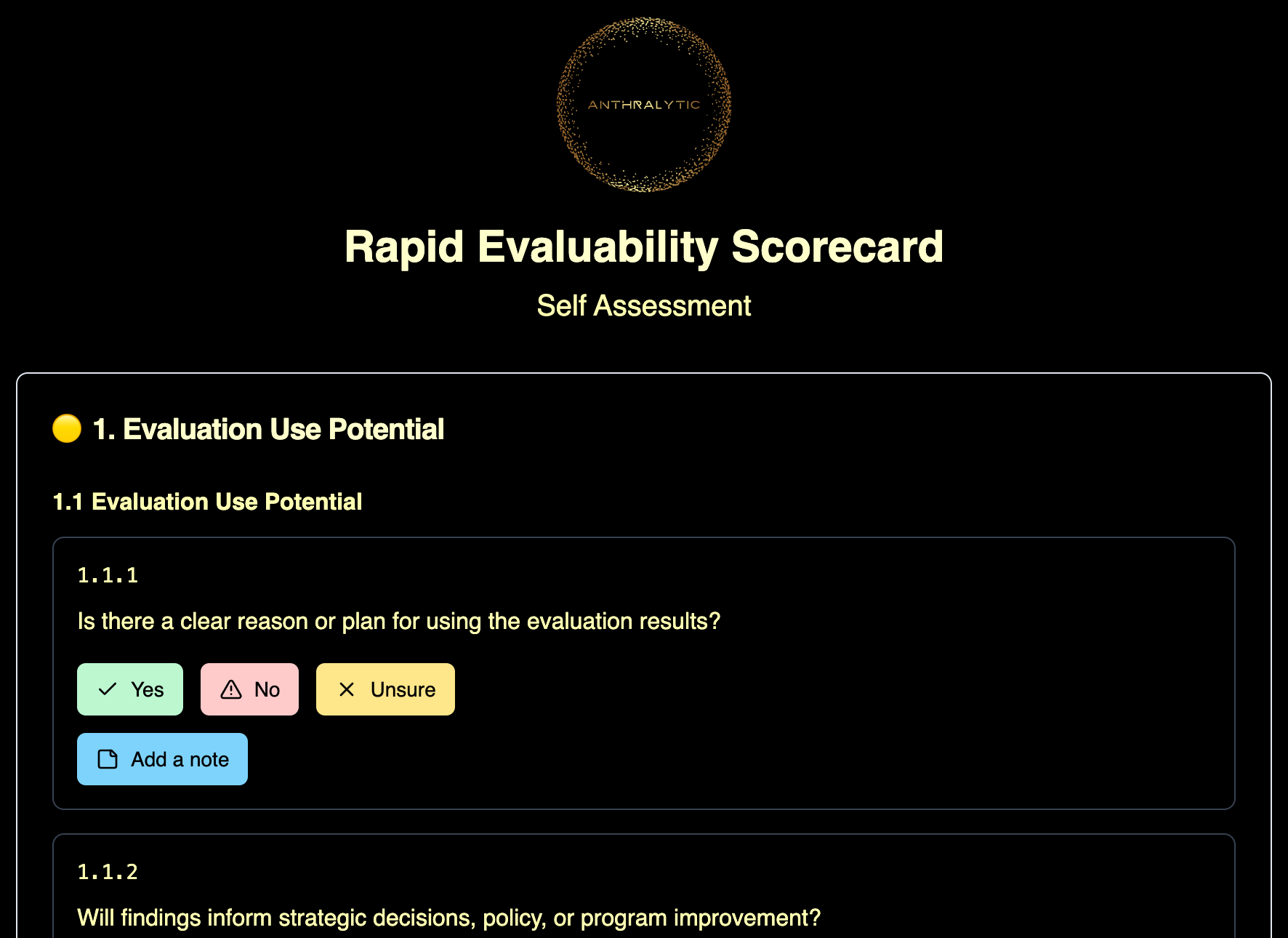
The scorecard walks you through six key domains that are important for evaluability:
Evaluation Use Potential – Is there a real plan to use the findings?
Stability of Operations – Is the program far enough along to show results?
Data Environment – Is the data relevant, available, and reliable?
Resources & Timing – Do you have the capacity to evaluate well?
Program Logic & Design – Are your goals clear and outcomes measurable?
Stakeholder Buy-In – Will the right people participate—and act?
Each section includes a series of Yes / No / Unsure questions, with brief explanations and scoring logic to help you understand where your project stands.
Some questions are conditional—appearing only when relevant—so the process stays focused and efficient.
What the Results Tell You
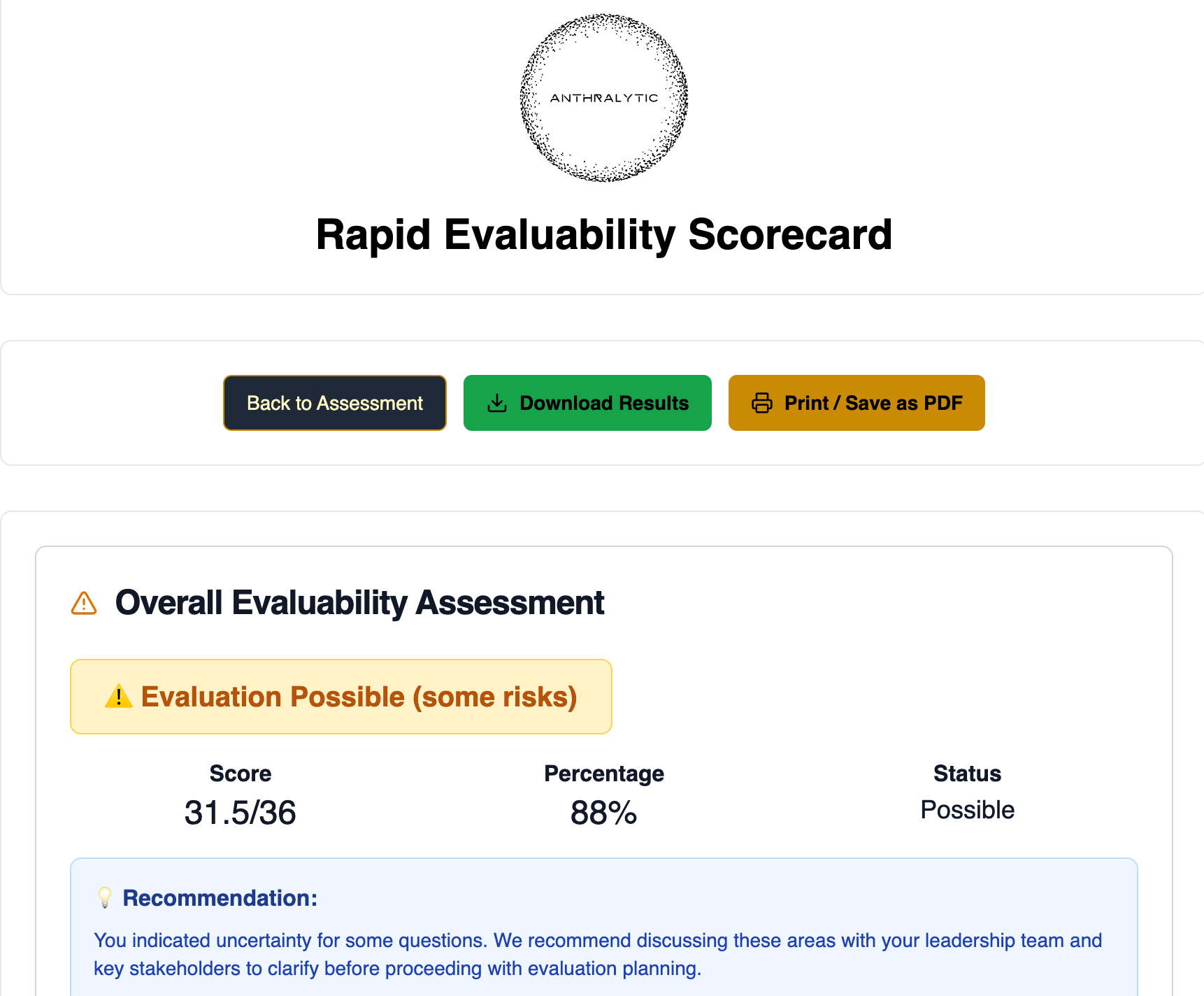
The results will tell you whether your initiative is ready for an evaluation and what the gaps are, if any, that need to be filled first. You can download and/or print the results.
Score Range
✅ 90–100%: Evaluation-Ready — strong foundation, green light.
⚠️ 70–89%: Some Gaps — fixable, but pause before moving forward.
❌ <70%: Not Evaluation-Ready — don’t waste time or resources yet.
Some elements must be in place before an evaluation is possible and/or useful. If you mark “no” for any of these must-haves, the evaluation results will be deemed not evaluable. Yet. But the good thing is you will know where to start to get there.
You’ll also get:
A category-by-category breakdown for each of the six domains
Specific, actionable recommendations
A downloadable summary to share with your team or funder
Here is an example (abbreviated for length):
Why I Built This
Because too many evaluations are rushed, underused, or done out of obligation.
And because no organization—especially scrappy teams and small nonprofits—should have to hire a consultant just to find out if they’re ready.
The Rapid Evaluability Scorecard exists to change that.
It’s free. It’s fast. It’s designed for access.
I built it with no coding background—just a clear need, and the support of AI tools that anyone can now use.
🚀 Try It Now (Free)
🔗 Launch the Rapid Evaluability Scorecard →
No signup. No paywall. Just a better decision, 15 minutes from now.
What’s Coming Next
This is just the first of many tools I’m building to help teams ask better questions—and act on the answers:
A Theory of Change Check-Up
Templates and walkthroughs for smarter strategy and learning
Subscribe to get them as they drop.
Anthralytic exists to make evaluation, strategy, and decision-making tools radically accessible. If you’re tired of frameworks that talk over your team—or reports no one reads—you’re in the right place.
— Sadie
Evaluability assessment was introduced by Joseph Wholey in the 1970s to help organizations determine if programs are ready for meaningful evaluation. Michael Quinn Patton later embedded it into Utilization-Focused Evaluation, while Carol Weiss laid the groundwork through theory-based approaches. E. Jane Davidson and others have since emphasized making evaluability practical, clear, and use-focused. For further reading: Wholey (1979) Evaluation: Promise and Performance; Patton (2008) Utilization-Focused Evaluation; Davidson (2005) Evaluation Methodology Basics.
Want to build your own no-code tool? Here’s the Loveable invite link and promo code I used.