

Yes, GPT-5 is making headlines. But this isn’t about that.
This is about GPT-OSS—OpenAI’s first truly open-source model since GPT-2.
That means you can now download and run a large language model with GPT-4–level reasoning on your own device. No paywall. No API fees. No internet required. No data leak risks. Just you and the model.
Sounds like a dream?
Now you can do qualitative interview coding, sentiment analysis, thematic clustering, quantitative data analysis… entirely offline. That’s a huge shift for evaluation and social impact work.
No more waiting on cloud APIs
No more worrying if uploading transcripts violates consent
No more vendor lock-in or region restrictions
The opportunity to build local AI agents—trained on your own frameworks and values—is now real.
But with great power comes great responsibility.
You’ve got three paths, choose wisely
🛑 Path 1: Hold Up!
You’ve heard about the benefits. You even agree that AI could act as a multiplier for impact. But you’re just not ready.
Maybe you’ve experimented a little. Maybe you’ve read the warnings about bias, hallucinations, and misuse. Your data is just too sensitive. You’re not convinced the benefits outweigh the risks—yet.
So you hold off. No AI, no agents, no integration.
But here's the problem: this isn’t a neutral choice. Holding off means missing out—on automation, acceleration, and impact amplification.
GPT-OSS is free, open, and offline. If you're in social impact work, this is your shot to use a cutting-edge model—on your own terms. Don’t let caution become complacency.
🚀 Path 2: Let’s Go!
You’re ready to run. Interview coding? P-value calculation? First drafts? Let’s go.
You’re deploying AI agents to handle the grunt work. You stay expert-in-the-loop, but the model’s doing the heavy lifting.
Fast. Scalable. Game-changing.
But... it’s still a general-purpose model. It wasn’t trained on your data or designed for your context—and that can show.
This is great for experimentation and internal workflows. But for anything sensitive, you might need more control.
⚠️ Path 3: Fine-Tune for Your Mission
You’re excited. But you start by customizing the model.
You fine-tune it with your organization’s voice, local dialects, evaluation frameworks, and subject matter data.
You want nuance. And nuance is what you bring.
You’ll still use agents. You’ll still automate. But you’re training the model to serve your mission—with less bias, less misinterpretation, and more relevance.
This takes some technical lift. But the payoff is long-term: a contextualized model that works for you, not just in general.
🎮 Cheat Code
Comparison Table: GPT-OSS vs. Cloud-Based AI
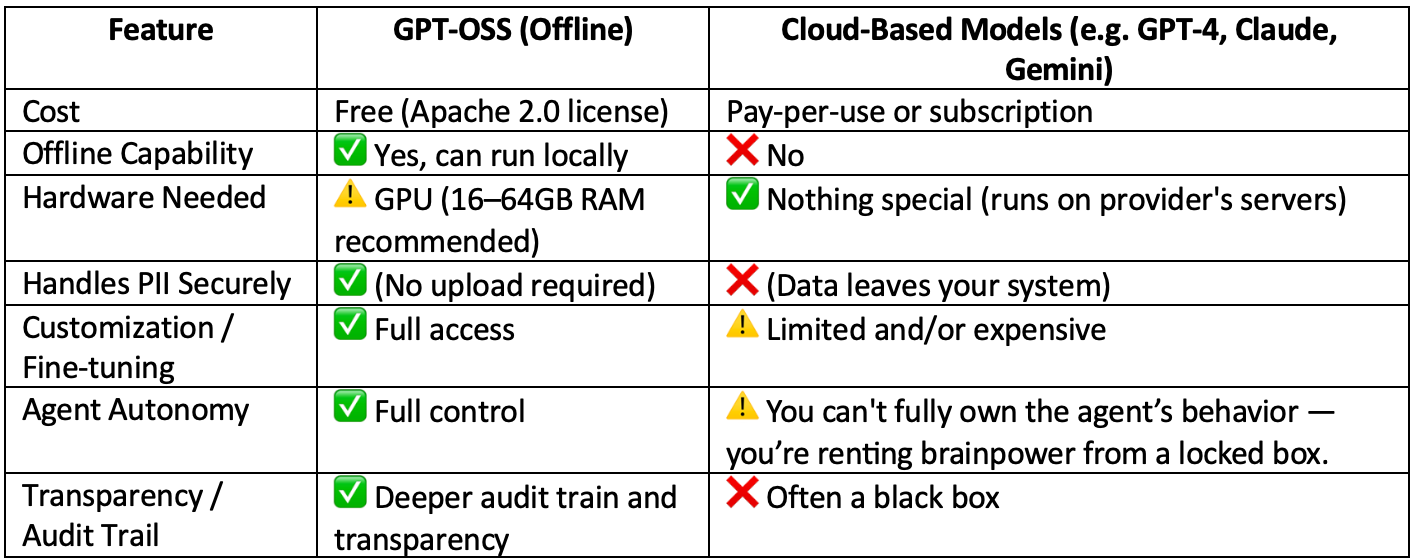
Choose wisely.
Bonus Round: Isn’t Meta’s LLaMA Also Open Source?
Well… kind of.
Meta’s LLaMA models are open-weight—which means the model files are available—but their license restricts commercial use and access in some regions. You can’t always use them freely in production.
In contrast, GPT-OSS is licensed under Apache 2.0:
Commercial use allowed
Global access
Fully modifiable
Offline deployment supported
That’s a game-changer for nonprofits, researchers, and evaluators—especially those working with sensitive data or in low-connectivity environments.
Whether you’re a program evaluator, nonprofit strategist, or social impact technologist—you now have a free, secure, and flexible AI toolkit.
The only question is: what will you do with it?
Anthralytic helps mission-driven teams use data, evaluation, and AI more effectively—without the jargon or gatekeeping. Subscribe for more grounded insights, practical tools, and strategy that actually fits your context.
