What I Saw Before I Knew How to Look
In Zen Buddhism, koans are questions designed to break your logical mind, to exhaust the part of you that thinks it can analyze its way to truth. When that part gives up, something else might open.
The classic example is “What is the sound of one hand clapping?” You cannot solve this by thinking harder. One hand does not make sound. The question forces you to abandon the framework, the assumption that sound requires two hands meeting. Zen students sit with koans for months or years, bringing answers to their teachers, getting rejected, trying again. The process is not about finding the right answer. It is about transforming the student. The koan works on you until you stop trying to master it.
Evaluators face a version of the same problem Zen students face. We are trained to analyze, to apply frameworks, to solve problems with systematic thinking. This is necessary. It is also limiting. Sometimes the framework is the problem. Sometimes the question we have been taught to ask is preventing us from seeing what is actually there. Sometimes we need to break out of evaluator mind entirely to see clearly.
Koans offer a way to practice that breaking. Not once, but as ongoing discipline. They point at the moments when expertise becomes obstacle, when the logic model blocks the view, when the thing you are most sure about is exactly what needs to be questioned.
Two koans in particular map the arc of evaluator formation: learning what you need to learn, recognizing when it becomes obstacle, and finding your way back to direct seeing without losing what you have gained.
Your Original Face
The first is this: “What was your original face before your parents were born?”
It asks for an impossible memory. You cannot remember before you existed. That is the point. The question is not about chronology. It is about identity beneath conditioning. Who are you before every learned thing? Before you were taught what to see and how to see it.
The koan assumes you had an original face. You saw directly once. Then layers accumulated. Training. Frameworks. Professional identity. The ways your field taught you to look. Each layer helped you see certain things more clearly. But each layer also obscured something that was visible before.
Evaluators know this pattern, even if we rarely name it. We learn theories of change, sampling strategies, validity threats. We learn what counts as evidence and what counts as noise. We learn the questions we are supposed to ask and the ones that sound unsophisticated. We learn to see like evaluators.
This is not corruption. It is formation. You need the training. The frameworks help. They give you ways to organize complexity, spot patterns, avoid obvious mistakes. Without them, you are just guessing.
But something happens when you get good at this work. The framework that helped you see becomes the thing preventing you from seeing. You show up to a program and you see the logic model before you see the people. You hear a participant’s story and you are already coding it into themes before they finish talking. You observe a practice and you are checking it against best practices instead of watching what is actually happening.
The obvious questions, the ones a newcomer would ask, start to feel beneath you. You have been trained out of them. Your original face, the one that saw directly before it learned how to look, is still there somewhere. But you cannot find it under all the expertise.
This is where the koans come in. The first one is about what was there all along. The second one is about what needs to die.
The Buddhas on the Road
The second koan is was said be Linji in ninth century China: “If you meet the Buddha on the road, kill him.”
The instruction is shocking. Why would a Buddhist master tell students to kill the Buddha?
Because even the Buddha, if he becomes an object of attachment, must be destroyed. If you cling to the teaching, the teaching becomes the obstacle. If you worship the master, you stop seeing what the master is teaching. The most sacred thing in your tradition is precisely the thing you need to be willing to release.
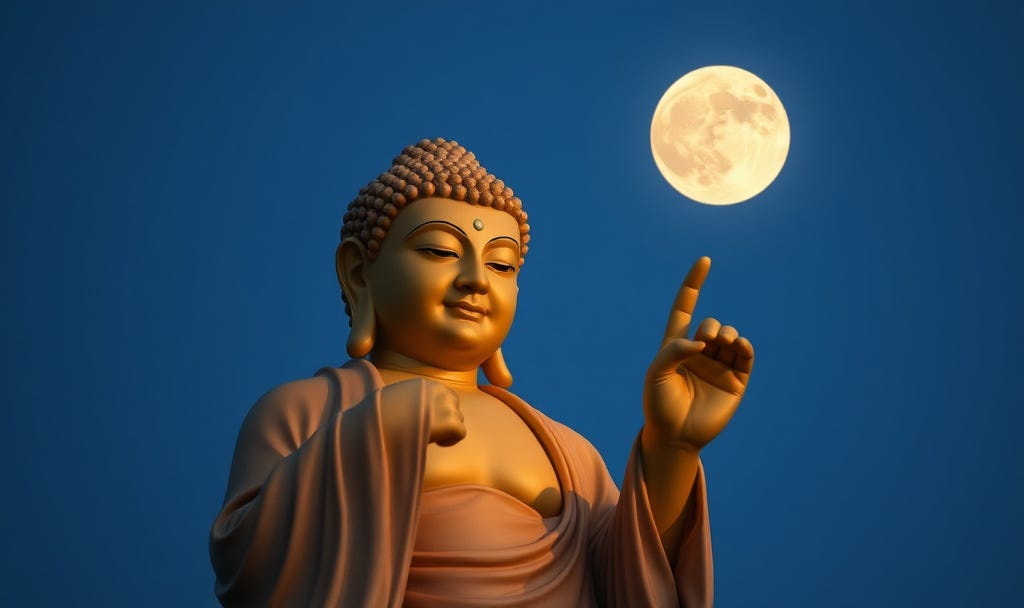
There is a related teaching: when a finger points at the moon, you must not mistake the finger for the moon. The finger is useful. It shows you where to look. But if you stare at the finger, you miss what it is pointing at. The framework is the finger. The program, the community, the actual thing happening in front of you is the moon. Your job is to see the moon. But if you cannot stop staring at the finger, if you cannot stop admiring how well-designed the pointing mechanism is, you will miss everything.
For evaluators, the Buddha is your framework. The theory you built your career on. The method you know better than anyone. The approach that made you good at this work. These are not bad things. You needed them. They helped you see. But if you cannot set them down when they stop serving, they become the problem.
I have my own Buddhas. Participatory evaluation. The belief that involving stakeholders produces better learning. I still think this is true most of the time. But I have also seen myself force participation into contexts where it did not fit, where the power dynamics made it performative, where people were too exhausted to want another meeting. I kept reaching for the framework because it was what I knew, what I trusted, what made me feel like a good evaluator. The Buddha was in the way.
Theory-driven evaluation is a Buddha. Logic models. Randomized controlled trials as the gold standard. Utilization-focused evaluation. Empowerment evaluation. Developmental evaluation. These are not equivalent in their claims or their politics. But any of them can become the thing blocking your vision if you are attached to being the person who does it that way.
The credential is a Buddha. The PhD. The years of training. The professional identity as someone who knows how to do this right. You earned those things. They matter. But if you cannot evaluate without performing your expertise, if you cannot sit with not-knowing because it threatens your sense of competence, then the credential is in the way.
The need to be right is a Buddha. You developed a hypothesis about what the program is doing. You collected data. You started seeing patterns. Then something contradicts your emerging interpretation, and instead of being curious, you defend. You explain it away. You look for reasons the contradictory data might be unreliable. This is human. It is also the Buddha blocking the road.
Rigor is a Buddha. Not the actual discipline of careful work, but the performance of it. The evaluator who cannot release a report because it is not perfect yet. The one who keeps collecting more data because the sample is not quite large enough. The one who buries findings in caveats to prove she considered every possible limitation. Rigor matters. Rigor as armor does not.
Even beginner’s mind can become a Buddha. I have seen evaluators perform not-knowing, make a show of their humility, use “I’m just asking questions” as a way to avoid taking a position. Beginner’s mind is not a brand. It is not something you achieve and then display. It is the practice of releasing what you think you know so you can see what is actually there. The moment you are proud of having it, you have lost it.
The koan says kill the Buddha. Not reject Buddhism. Not abandon what you have learned. Kill the attachment. The framework is useful until you cannot imagine evaluating without it. The method helps until you start defending it more than you care about what it reveals. The expertise serves until you cannot risk being wrong.
What does killing look like in practice? You notice. That is the first move. You notice when you reach for the framework out of habit instead of necessity. You notice when you are performing expertise instead of thinking. You notice when you get defensive about your approach, when someone questions it and you feel threatened instead of curious.
Then you release. Not permanently. Not forever. Just for this moment. Just long enough to see if something else becomes visible when you are not looking through that particular lens. You set down the logic model and watch what is actually happening. You stop coding the interview and listen to what the person is saying. You let go of needing to be the expert and ask the obvious question.
This is not easy. Your identity is wrapped up in these Buddhas. You might not know who you are as an evaluator without them. That is exactly why they need to die. Not because they are wrong, but because your attachment to them prevents you from seeing clearly.
The practice is not to kill the Buddha once and be done. The practice is noticing when the Buddha is back on the road, and killing him again. Frameworks are useful. Use them. And then set them down before they become the only thing you can see through.
After you kill the Buddha, what is left? That is where the first koan returns.
The Face That Was Always There
After you kill the Buddha, what is left?
Let’s return to the first koan: “What was your original face before your parents were born?”
You cannot go back to not knowing. You cannot unlearn the frameworks, forget the training, pretend you never earned the credential. The knowledge stays. But after you release your attachment to it, something else becomes available. The capacity to see directly. The willingness to be surprised. The obvious questions you were trained out of asking.
This is not naiveté. You are not recovering childhood ignorance. You are recovering the ability to see what is actually there instead of what your frameworks predict should be there. The original face is not innocent. It is clear.
There is a Zen teaching attributed to Qingyuan Weixin that describes this return. He said: “Before I studied Zen for thirty years, I saw mountains as mountains and rivers as rivers. When I arrived at a more intimate knowledge, I came to the point where I saw that mountains are not mountains and rivers are not rivers. But now that I have got its very substance, I am at rest. For it is just that I see mountains once again as mountains, and rivers once again as rivers.”
The arc is this: you saw clearly once. Then you learned to see through and beyond, recognizing complexity invisible to untrained eyes. The mountains were not just mountains anymore. They were geological formations, watersheds, ecosystems, symbols, sites of contested meaning. This knowledge was real. It helped. But it also made it harder to see the mountain.
After you travel further, the mountain becomes a mountain again. Not because you forgot what you learned, but because you can hold the knowledge lightly enough that it does not block the view. You see the mountain and you see all the complexity, but the complexity does not prevent you from seeing the mountain.
Evaluation has the same arc. You see a program. Then you learn to see logic models, theories of change, implementation pathways, confounding variables, all the apparatus of methodological sophistication. The program is not just a program anymore. This is necessary. You needed to learn this.
But somewhere in that middle stage, you stop seeing the program. You see the framework. You see what you expected to find. You see what your training taught you to look for. The program becomes invisible under the weight of your analysis.
After you kill the Buddha, the program becomes a program again. You can still use the frameworks. You still know what you know. But now you can set them down when they stop serving. You can see what is actually happening without needing to fit it into categories first.
This is what the original face looks like after formation. Not the face you had before you knew anything, but the face that can see directly even though it knows a great deal. The difference is attachment. You hold what you know lightly enough that you can still be taught.
The Practice
What does this look like in practice? You conduct an interview and you listen to what the person is saying instead of waiting for them to say the thing that fits your coding scheme. You observe a program and you watch what is happening instead of checking it against the logic model. You review findings and you stay curious about what contradicts your hypothesis instead of defending your interpretation.
You ask the questions that feel too simple. Why did this happen? What do you think is going on? What am I missing? These are not sophisticated questions. They are original face questions. The ones you would ask if you were not trying to prove you know what you are doing.
You notice when you are seeing through the framework instead of seeing the thing itself. This is the practice. Not to never use frameworks, but to notice when the framework has become the only thing you can see. Then you set it down, just for a moment, and look again.
The original face is not a destination you arrive at. It is not something you achieve after years of practice and then possess forever. It is a return you make again and again. You drift into expertise, into performance, into attachment to being right. Then you notice. And you come back.
The two koans are not separate practices. They are the same movement. Let go of expertise, remember how to look. This is not rejection of what you learned. It is holding what you learned lightly enough that it serves instead of constrains.
You still have the frameworks. You still use them. But now you can also set them down. You know what you know, and you can still be surprised. You have traveled far from where you started, and you have returned to see the mountain as a mountain again. Only now you are not innocent about it. Now you know what you are choosing when you choose to see directly.
The practice is simple. Not easy, but simple. Notice when you’re staring at the finger. Look at the moon. Return when you drift. Repeat.
Sometimes in my work I still catch myself staring at the finger instead of the moon. Where I reach for the framework out of habit and miss what is actually happening. Where I perform expertise instead of admitting I do not know. Where the Buddha is back on the road and I forget to kill him.
The difference now is that I notice. Not always in the moment, but eventually. I catch myself defending my interpretation when I should be curious. I realize I have been looking at the logic model instead of watching the program. I see that I asked a question to show I know things rather than to learn something.
Then I come back. I set down the framework. I ask the obvious question. I look at what is actually there instead of what I expected to find. This is the practice. Not perfection. Just noticing and returning.
The koans are not puzzles to solve once and file away. They are practices to return to. Questions that keep working on you. When you meet the Buddha on the road, what do you do? When you notice you are staring at the finger, where do you look? What was your face before all the training? Can you find it again, just for a moment?
These are not rhetorical questions. They are invitations to actual practice. The next time you show up to an evaluation, pause before you pull out your framework. Ask yourself: what would I see if I did not already know what to look for? The next time you find yourself defending your approach, pause. Ask yourself: am I attached to being right, or am I trying to see clearly?
The next time someone asks an obvious question and you feel that familiar dismissiveness, that sense that the question is beneath your expertise, pause. That is the Buddha on the road. That is the finger blocking your view of the moon. That is the moment to practice.
You will forget. The Buddha will be back tomorrow. The framework will obscure your vision again. You will stare at the finger and miss the moon. This is not failure. This is the practice. Notice. Release. Look again. Return when you drift.
The mountains are mountains. They were always mountains. You just had to learn to see them that way again.
Anthralytic is a strategy and evaluation studio that helps mission-driven teams clarify and amplify their impact. If this piece landed, sit with it for a bit. The koans work better when you let them work on you.
Glad you’re here.