

There's an enormous amount of energy in the social sector dedicated to improving how organizations measure their impact. Most of it is aimed at the wrong people.
I had a conversation recently that helped me name the thing I’ve been seeing for a long time. I’ve known the pattern was there. I just hadn’t put my finger on it.
Let’s dive in.
One way to conceptualize the social sector’s relationship to measurement, evaluation, and learning is a two-by-two. Understanding which quadrant you’re talking to changes everything about what you build and who you build it for.
The Two-by-Two
If you map organizations on two axes, openness to better measurement and potential gain from better tools, four quadrants emerge.
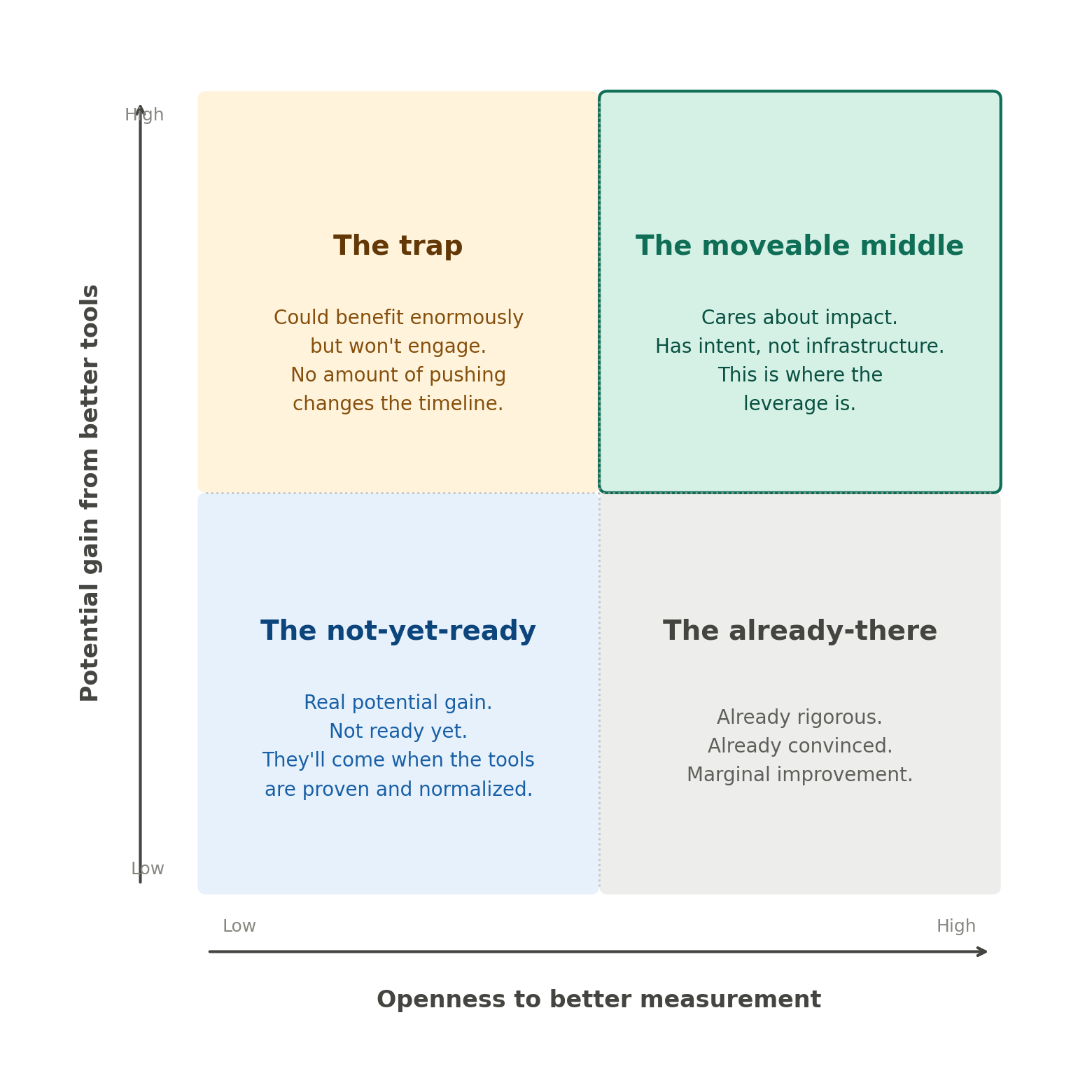
The not-yet-ready sit in the lower left. Low openness, real but unrealized potential gain. These are organizations doing critical work, providing beds, meals, services, holding communities together with sweat and grit. They’re not hostile to measurement. They’re just focused on something else right now. The potential gain is real, but the readiness isn’t. They’ll come when the tools are proven, normalized, and easy enough that adoption doesn’t feel like a project.
The already-there sit in the lower right. High openness, low marginal gain. Organizations with dedicated evaluation staff, external evaluators, quasi-experimental designs. They’re already doing it. They’re already convinced. Better tools might sharpen their work, but the most sophisticated organizations in any sector are not where the unlock is.
The trap sits in the upper left. Low openness, high potential gain. Organizations that could benefit enormously from better tools but won’t engage. Maybe it’s leadership resistance, maybe it’s cultural, maybe it’s just not the right moment. The temptation is to pour energy here because the theoretical payoff is so large. But theoretical payoff and actual adoption are different things, and the field has spent decades learning that lesson the hard way.
The upper right is high openness and high potential gain. Organizations that care about impact, are open to better approaches, and where the gap between where they are and where they could be is enormous. The two-by-two tells you this is the highest-return quadrant. But the two-by-two alone doesn’t tell you what’s actually happening inside it.
For that, I want to shift to a different frame, one grounded in social and behavior change science.
The Moveable Middle
The term “moveable middle” comes from public opinion research, where it describes the segment of an audience that isn’t already committed but can be reached with the right message and the right tools. If you know Rogers’ Diffusion of Innovation model, you’ll recognize the pattern. The already-there are the early adopters. They moved first because they had the resources and the conviction. The not-yet-ready are the late majority. They’ll come when the path is clear. And the moveable middle is the early majority, the group that determines whether better measurement ever becomes normal in the social sector.
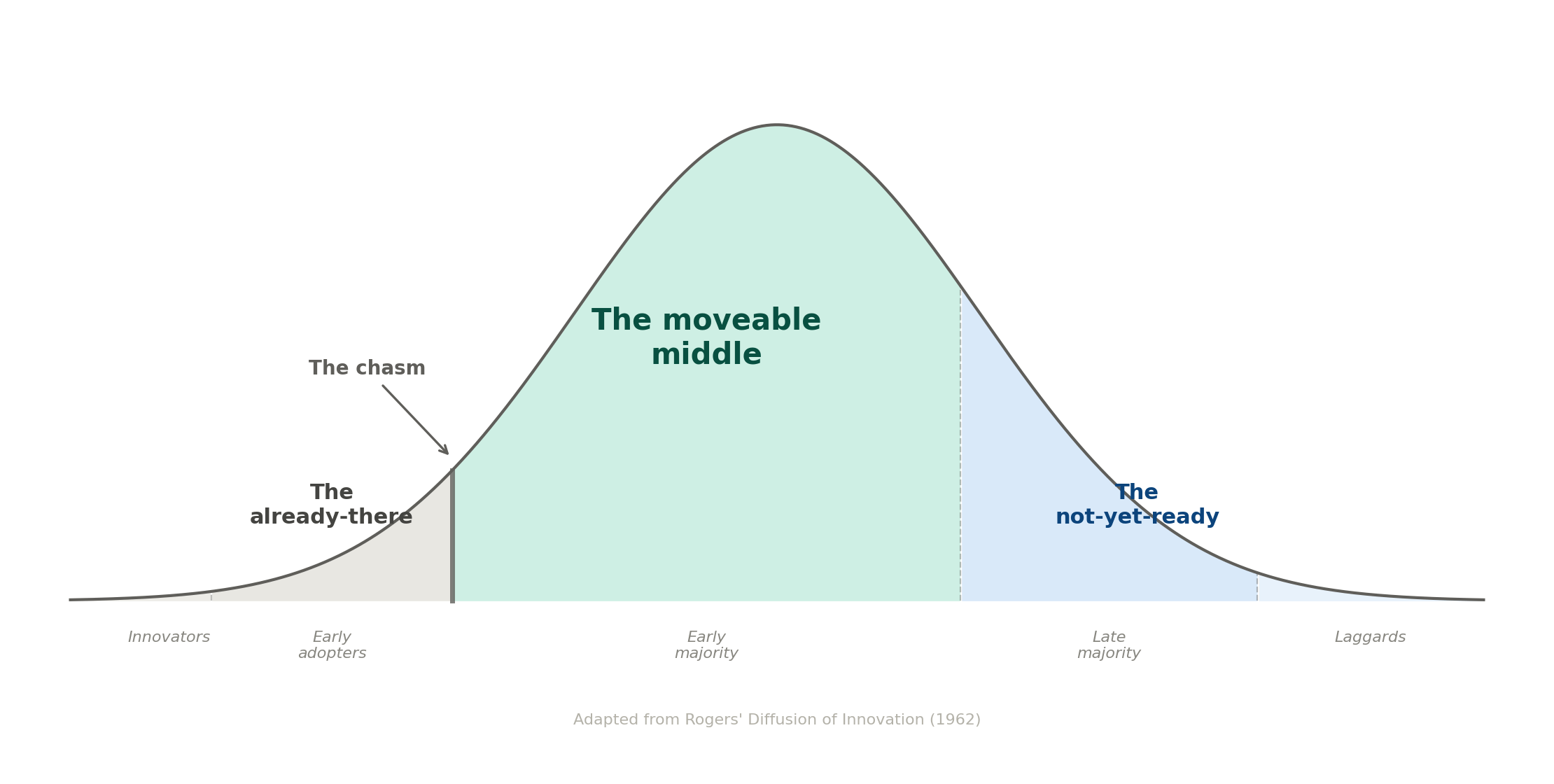
The chasm in Rogers’ model falls exactly where the design problem lives: between the organizations that already do this work and the ones that would, if someone built the bridge. I’m borrowing this frame because the two-by-two tells you where organizations sit. The moveable middle, and the diffusion curve behind it, tells you why they’re stuck and what it takes to move them.
These are organizations that care about impact. They’re already doing some form of measurement. But they’re trapped in what I’d call the compliance loop: tracking what the funder asks for rather than what would actually help them learn and improve. Historically, nonprofits have focused on evaluating social impact to meet reporting requirements, with limited space to innovate or leverage evidence from their own services. Lean staffing and restricted funds keep them locked in that cycle, tracking outputs for compliance instead of learning what’s working.
And here’s the part that should bother everyone: both sides lose. Grantee organizations report on indicators that may be less useful to them, often at the expense of more mission-critical work. And funders, despite requiring those measures, end up with a shallow understanding of what their money actually did.
The middle isn’t opposed to doing this better. They face a capacity gap: not enough funds, not enough people, not enough time, not enough evaluation expertise, and too little support from boards and leadership. It’s not that they don’t want to think more carefully about impact. It’s that they can’t afford to, and nobody has shown them a right-sized version of what that looks like.
I’ve seen this up close. Organizations that can’t answer basic questions about their own effectiveness because nobody set up the system to find out. Organizations that call asking for “an evaluation” when what they actually need is help with program design. I once had a client ask for “an evaluation” and mean two completely different things in two different conversations. The terminology itself is a barrier. Words like “evaluation” and “performance management” shift meaning depending on who’s in the room, and the confusion starts before anyone picks up a survey instrument.
This is the moveable middle in practice. They have the intent but not the infrastructure. They’re not a hard sell. They’re an unserved market.
Here’s the thing about the moveable middle: they’re not resistant. They’re the first in line for something built for them. The already-there adopted sophisticated evaluation years ago because they had the budget and the staff. The moveable middle will move the moment someone bridges the chasm with the right tools at the right scale. And when they do, when they have results to show, the not-yet-ready won’t be far behind.
The Design Problem
The social impact field keeps building for the already-there and then wondering why nobody else adopts it. We produce sophisticated frameworks, dense methodological guides, and expensive consulting engagements that assume organizations already have the capacity to absorb them. Then we’re puzzled when the moveable middle keeps doing what it’s always done: tracking outputs for the funder report and calling it evaluation.
What the moveable middle needs isn’t a watered-down version of what the top tier uses. It needs something fundamentally different: right-sized tools for the full cycle of monitoring, evaluation, and learning. Tools that start where organizations actually are, not where we wish they were.
The advice that resonates most with me is the simplest. Start with a back-of-the-envelope theory of change. Ask: what do you know and not know about how you are making an impact? Prioritize what to measure based on what you don’t know. Start small and early. Go through the cycle once, then iterate. Don’t build a dashboard. Track three metrics in a spreadsheet and review them during a leadership call.
That’s not dumbed-down rigor. That’s rigor that fits.
What I’m Building
This is the space Anthralytic works in, and it’s where I’ve been putting my energy.
I’ve been experimenting with lightweight tools designed specifically for the moveable middle. An evaluability assessment that helps organizations figure out what they’re actually ready to measure before they spend money finding out. An impact wizard that walks teams through the basics of articulating their theory of change without requiring a consultant in the room. These are early experiments, but they’ve confirmed something I suspected: when you meet organizations where they are, with the right language and the right scope, they move. Quickly.
What I’m building now takes that further. It’s a set of tools and targeted consulting designed to help nonprofits through the full cycle of monitoring, evaluation, and learning. Not a $40,000 evaluation. Not a team of PhDs. Something accessible, right-sized, and designed for organizations that have the intent but not the infrastructure. Something that makes measurement useful instead of performative.
If the moveable middle is where the real leverage is, then the solution has to be built for the middle. That’s what I’m doing.
Anthralytic is a strategy and evaluation studio helping mission-driven organizations clarify and amplify their impact.