This Morning I Became a Witness
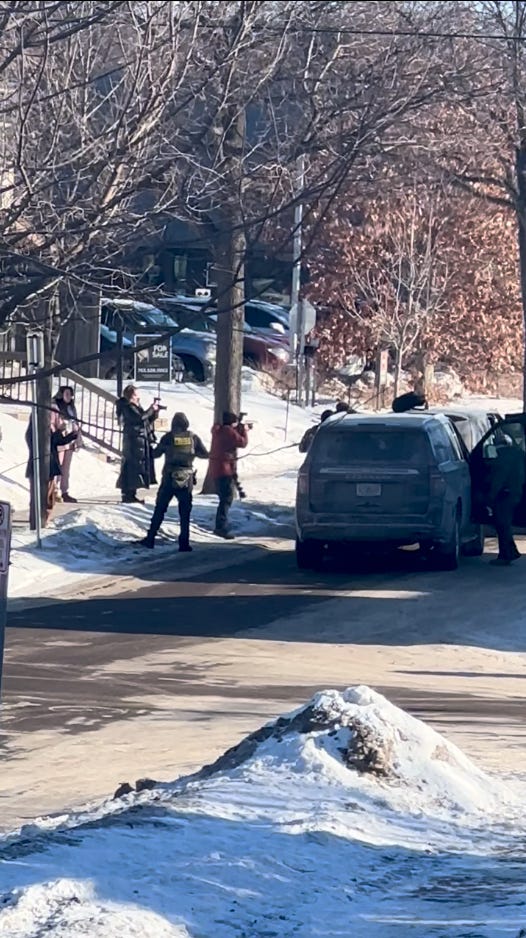
This morning I was looking out my window in Minneapolis when I saw it happening.
ICE agents. A person being taken. Right there on the street where I live.
There were already people gathered. Phones out, filming. Documenting what was happening in real time. Exercising their constitutional right to observe law enforcement in public spaces.
I grabbed my phone too. Not because I knew what to do with the footage. Not because I had a plan. But because something in me said: this needs to be seen. Someone needs to be watching. This cannot happen without witnesses.
I stood at my window and recorded. My hands shook. I did not know if I was doing it right, if the video was clear, if it mattered. I just knew I could not look away.
This is what communities across Minneapolis have been doing for weeks. Standing outside schools during morning drop-off. Monitoring courthouses. Watching for enforcement vans. Recording when ICE shows up. Making sure no one is taken without someone knowing, without someone documenting, without someone bearing witness.
That is when I understood something I had only known abstractly before: this is not theoretical. This is not a case study. This is not an interesting organizing strategy to analyze. This is people protecting their neighbors in real time because the alternative is to let enforcement happen without witnesses, without accountability, without anyone to call that person’s family and say what happened. Without anyone to make sure their children get picked up from school. Without anyone to take care of dependents left behind. Without anyone to move their car out of the road before it gets towed. Without anyone saying: I saw this. It happened. This person was here, and then they were taken, and here is what they will need.
Earlier that same morning, I learned that Kash Patel, head of the FBI, announced that the Bureau would be investigating people in Minneapolis who use Signal, the encrypted messaging app. He did not specify a crime. He did not cite a statute. He just said: we are watching you, and we know how you communicate.
The threat was not directed at ICE. It was directed at the people doing what I had just done. Watching. Documenting. Making sure enforcement does not operate without witnesses.
This is not a warning about terrorism or organized crime. This is a threat aimed at community organizing. At the networks of people who text each other when enforcement vans appear in their neighborhoods. Who help families know their rights. Who document what happens when agents show up without warrants and take parents in front of their children. Who make sure that what I witnessed this morning does not happen in the dark.
And I realized: if filming from my window makes me part of this network, if that documentation could be seen as coordination, if bearing witness is now something the FBI investigates, then we need to be very clear about what is actually happening here.
What these communities are doing what I did this morning without thinking is lawful.
Watching for ICE raids is protected First Amendment activity. Using encrypted communication is legal. Organizing to help each other is a fundamental democratic right. Documenting civil rights violations is not only legal but necessary for accountability.
What ICE is doing is not lawful.
Arrests without judicial warrants. Detentions without due process. Separation of families without plans for reunification. Targeting of legal residents. Entry into homes without consent or exigent circumstances. Taking a five-year-old child whose family has legal asylum and using him as bait to detain his parents. These are constitutional violations, happening daily, witnessed by communities who have every right to watch and every right to warn each other.
The question is not whether communities should be allowed to protect their own. They do not need permission. The question is whether the rest of us will let a lawful democratic practice be reframed as suspicious simply because it makes enforcement harder to conduct without witnesses.
Let’s Be Clear About What’s Lawful Here
Community protection activities are constitutionally protected. This is not a gray area. This is not legally ambiguous. This is settled law.
Observing law enforcement in public spaces is a recognized right. The First Amendment protects the right to record police activity. This was established in Glik v. Cunniffe (2011), where the First Circuit held that filming government officials, including law enforcement, in public spaces is protected speech. The Seventh Circuit affirmed this in ACLU v. Alvarez (2012). The Eleventh Circuit in Smith v. City of Cumming (2013). The Third, Fifth, and Ninth Circuits have all ruled similarly. When communities watch for ICE raids, when they film enforcement actions, when they document who gets taken and under what circumstances, they are exercising a constitutional right.
Using encrypted communication is legal. Signal is not a tool for criminals. It is a tool for anyone who values privacy. Journalists use it to protect sources. Lawyers use it to protect client confidentiality. Domestic violence advocates use it to keep survivors safe. Businesses use it to protect trade secrets. The fact that community organizers use it to coordinate lawful activity does not make it suspicious. It makes it smart.
Freedom of association is protected. The First Amendment guarantees the right to associate with others for expressive purposes. Community organizing, mutual aid networks, and collective action are all protected associational activities. The Supreme Court established this in NAACP v. Alabama (1958), recognizing that compelled disclosure of membership lists would chill protected association. When communities form networks to protect their members, they are exercising this right.
Know-your-rights training is protected educational activity. Teaching people what to do if law enforcement approaches them is not obstruction. It is civic education. The right to remain silent, the right to refuse entry without a warrant, the right to speak to a lawyer: these are constitutional rights. Teaching people how to exercise their rights is not helping them evade the law. It is helping them understand the law.
Community organizing is fundamental democratic practice. People have the right to gather, to share information, to coordinate responses to threats, to care for each other. This is not radical. This is how communities have always functioned. Neighborhood Watch programs do this. PTAs do this. Every tenant association, every mutual aid network, every community response to crisis operates on these same principles: watch for threats, warn each other, coordinate protection.
The fact that ICE is the threat being watched does not change the legal analysis. The right to observe law enforcement does not disappear when the enforcement targets immigrants. The right to use secure communication does not become suspicious when the communication coordinates resistance to state power.
This is not new. Communities have always protected their own when the state failed to protect them or actively endangered them. The Underground Railroad helped enslaved people escape bondage. The sanctuary movement in the 1980s sheltered Central American refugees fleeing death squads. Japanese American networks during World War II helped families preserve dignity during unconstitutional internment. LGBTQ communities during the AIDS crisis built care networks when the government refused to respond. Domestic violence networks move survivors to safety, sometimes in defiance of custody orders, using encrypted communication and coordination across state lines. The principle is the same every time: when state power targets vulnerable people, communities organize to protect them. When the law is unjust, when enforcement is brutal, when institutions fail to protect those they are supposed to serve, people take care of each other. This is not criminal conspiracy. This is mutual aid. This is democracy functioning when government does not.
What Minneapolis communities are doing now follows this same tradition. They are watching. They are warning. They are helping people understand their rights. They are documenting violations. They are making sure no one faces enforcement alone.
The difference between this and Neighborhood Watch is only who is being protected. Neighborhood Watch programs coordinate to prevent crime. They watch for suspicious activity. They report to police. They use apps and encrypted chat groups. No one investigates them for using Signal.
But when communities watch for ICE, when they warn immigrant neighbors, when they document enforcement that violates due process, suddenly this becomes suspicious. Suddenly encrypted communication is evidence of something sinister. Suddenly mutual aid looks like obstruction.
The only thing that has changed is who is being protected. The activity is the same. The constitutional protections are the same. The right to organize is the same.
What these communities are doing is lawful. It is protected. It is necessary. And it is working, which is why the threat has come.
What ICE Is Actually Doing (The Lawbreaking Part)
Let’s talk about what is actually illegal here.
ICE operates outside constitutional constraints. This is not rhetoric. This is pattern and practice, documented by legal observers, civil rights organizations, and communities themselves. That is why community members are watching and recording. What they are witnessing are constitutional violations.
Due process violations. The Fifth Amendment guarantees that no person shall be deprived of liberty without due process. ICE arrests people without judicial warrants, detains them without charges, holds them without hearings for months, denies access to counsel, and conducts removal proceedings with no right to appointed counsel and judges who work for the executive branch.
Fourth Amendment violations. Agents enter homes without consent or emergency justification. They conduct pretextual traffic stops, detaining people far longer than justified to verify immigration status. They set up checkpoints in interior neighborhoods, stopping people based on appearance and language. The Second Circuit ruled in United States v. Vasquez-Alvarez (2019) that ICE lacks authority to enter homes without consent or a judicial warrant. The Supreme Court held in Arizona v. United States (2012) that prolonged detention to verify immigration status violates the Fourth Amendment. ICE does it anyway.
Family separation. Parents are being detained during school drop-off and pick-up. Children watch them taken. No plan for who will care for the children. No notification to family members. The ACLU has documented cases where children were left at schools with no one to pick them up, where infants were left with neighbors who had no legal authority to care for them, where families were not reunified for months or ever. The Flores Settlement Agreement and the Trafficking Victims Protection Reauthorization Act are violated regularly. Family separation is used as deterrent, which means it is punishment without trial.
Targeting legal residents and pending cases. Green card holders detained. People with work permits arrested at their jobs. People with pending asylum cases taken before their hearings. People arrested at routine check-ins. This disrupts any path to legal status and makes it functionally impossible to prepare cases or meet with lawyers.
Using children as bait. Taking a five-year-old child whose family has legal asylum and using him to lure parents into detention. This is predation, not law enforcement.
Workplace raids as union-busting. ICE raids workplaces right after workers file labor complaints, organize, or claim wage theft. The workers who spoke up get arrested and deported. The employers face no consequences. In Agri Processor Co. v. NLRB (2008), an ICE raid was timed to interfere with a union election.
Violence and deaths in ICE custody and enforcement. ICE enforcement has resulted in deaths. Renee Good and Alex Pretty are among those killed during or following ICE encounters. People have died in ICE detention facilities from medical neglect, inadequate care, and conditions that violate basic human rights standards. People have died during raids and enforcement actions.
At the detention facility in Florida, people are missing. The facility has been called “Alligator Alcatraz” for its remote location surrounded by swamps. But this is not Alligator Alcatraz. It is Alligator Auschwitz. This is a place where people disappear. Where families cannot find their loved ones. Where accountability is impossible because the facility operates in isolation, deliberately placed where oversight cannot reach.
The violence is not theoretical. It is documented. It is ongoing. People are dying. People are disappearing.
The pattern is clear. ICE does not simply enforce immigration law. It operates outside the constitutional constraints that apply to all law enforcement. It violates due process. It conducts warrantless searches. It separates families without legal authority. It targets people pursuing legal status. It retaliates against workers asserting their rights. It uses children as tools of enforcement. And its operations have led to deaths and disappearances.
This is what communities are witnessing when they watch for raids. This is what they are documenting when they record enforcement actions. This is what they are protecting each other from when they warn that ICE is in the neighborhood.
They are not helping people evade legitimate law enforcement. They are watching constitutional violations happen in real time and refusing to pretend that warrants are being obtained, that due process is being followed, that families are being kept together, that people are being treated as the Constitution requires.
When communities organize to protect their members from this, they are not obstructing justice. They are bearing witness to injustice. And they have every legal right to do so.
Communities Are Already Learning (And That’s Lawful Too)
Here is what needs to be understood: communities protecting their own are not operating in chaos. They are learning, systematically, in real time.
They track patterns. They notice when and where enforcement appears. They share information. People warn each other. They adapt tactics based on what they learn. Something stops working, so they try something else. This is iterative learning.
They provide know-your-rights training. Not once, but ongoing. They teach: you do not have to open the door without a warrant. You do not have to answer questions. You have the right to remain silent. You have the right to a lawyer. These are constitutional rights. Teaching people how to exercise them is civic education.
They connect people to legal resources. Lawyers who will take calls when someone gets arrested. Legal observers who will document what happened. Organizations that provide emergency support. This is a safety net built by people who know the state will not catch them.
They document violations for accountability. They record interactions when ICE shows up. They write down what happened, who was taken, whether warrants were shown. Sometimes they share it with legal advocates. Sometimes they just keep it, in case it is needed later. This is the only accountability mechanism that exists when enforcement operates without oversight.
This is sophisticated organizing. There are communication protocols. There are designated roles. There are decision-making structures. There are debriefs after actions to talk through what worked and what did not. There is institutional memory being built, even without institutions.
And it is working. People are not being taken without someone knowing. Families are not being separated without someone documenting it. Workers are not disappearing without their coworkers noticing. The surveillance goes both ways now. ICE is being watched while they watch.
This is why the threat has come. Not because communities are doing something illegal. But because they are doing something effective.
The Intimidation Tactic: Making Lawful Activity Seem Suspicious
Kash Patel did not announce an investigation into a crime. He announced surveillance of a communication tool. No statute cited. No specific violation alleged. Just: we are watching people who use Signal in Minneapolis.
This is how intimidation works. The vagueness is the point. It makes people guess what might be criminal, second-guess whether organizing is worth the risk, and turns lawful activity into something that feels dangerous.
When Neighborhood Watch groups coordinate through apps, no one investigates them. When businesses use encrypted communication, no one threatens FBI scrutiny. The activity is the same. The constitutional protections are the same. What changes is who is doing it and who is being protected.
The effect is already working. People are asking: Should I delete Signal? Should I stop going to meetings? Should I keep my head down? This is the chilling effect—abandoning constitutional rights not because they have been taken away, but because exercising them feels too risky.
The target extends beyond the communities being protected. Lawyers who take these cases. Legal observers who document arrests. Journalists who report on raids. Anyone whose presence makes enforcement more visible and accountable must now calculate risk. The threat does not need prosecution to succeed. It just needs to make people uncertain enough to pull back.
This is how state power expands when it cannot change the law. The Constitution protects organizing, observing law enforcement, using encrypted communication, and helping each other. Those rights cannot be easily legislated away. So instead, they are made to feel dangerous. The law does not change. The willingness to exercise rights does.
What makes this particularly insidious: the threat comes from the FBI, not ICE. The message is clear: if you help communities protect themselves from immigration enforcement, you are not just interfering with ICE operations. You are a domestic threat. The FBI watches you. This expands who can be targeted and under what justification, shifting from immigration law to domestic security with its broad authorities to investigate and surveil people who have not been charged with any crime.
It is designed to isolate. To make people wonder if the person next to them might be an informant. To fracture the networks that make community protection possible.
The intimidation works only if people believe the threat applies to them. So let’s be clear about what the law actually is:
Using Signal is legal. The Supreme Court has repeatedly held that people have a reasonable expectation of privacy in their communications. Encryption protects that privacy. Using it is not evidence of wrongdoing.
Organizing to observe law enforcement is legal. The First Amendment protects it. Courts have affirmed it.
Warning people about enforcement activity is legal. Sharing information is protected speech. Helping people exercise their constitutional rights is civic participation, not obstruction.
Community protection networks are legal. Mutual aid is not conspiracy. Coordination is not criminal. Helping people survive is not a federal offense.
The threat to investigate these activities does not make them illegal. It makes the threat itself an abuse of power. When law enforcement uses the possibility of investigation to chill lawful activity, that is the violation—not of criminal law, but of the constitutional principles that limit state power.
The appropriate response to intimidation is not compliance. It is clarity.
What these communities are doing is lawful. The threat against them is designed to suppress constitutional rights. If the FBI wants to investigate people for using encrypted communication to coordinate lawful organizing, they should say clearly what crime they believe has been committed.
Because surveilling people for exercising their rights is not law enforcement. It is suppression. And communities have the right to continue protecting their own whether the state approves or not.
Why This Matters Beyond One Community
This is not just about Minneapolis. This is not just about immigration enforcement. This is not just about one FBI director’s threat against one organizing network.
The precedent being set reaches far beyond ICE raids.
If organizing to document constitutional violations becomes grounds for investigation, then all accountability for state power becomes harder. If using encrypted communication makes you suspicious, then every journalist, every lawyer, every advocate protecting vulnerable people operates under a cloud. If community protection networks are treated as potential threats, then mutual aid itself becomes risky.
What is at stake:
The right to observe law enforcement in public spaces. Established in multiple circuit courts. Protected by the First Amendment. If that right can be chilled by threatening investigation, then police accountability becomes impossible. Every filming of an arrest. Every documentation of a stop. Every witness to enforcement. All of it becomes something people do while wondering if they are being watched for watching.
The right to organize for mutual protection. Communities have always done this. Neighborhood watches. Tenant associations. Parent networks. Mutual aid collectives. When some of those networks become “suspicious” because of who they protect or what they protect against, the right itself erodes. Not legally. But practically, because people become afraid to exercise it.
The right to use secure communication. Encryption protects privacy. Privacy is a constitutional value. Journalists use it. Lawyers use it. Doctors use it. Businesses use it. When its use becomes evidence of wrongdoing in one context, it casts suspicion on its use in all contexts. People start choosing between security and appearing innocent.
The right to help each other survive. Mutual aid is not charity. It is how communities function when institutions fail them or actively harm them. Food shares. Childcare networks. Emergency funds. Rides to appointments. Information about where threats appear. When helping each other becomes something that draws investigation, community resilience itself becomes suspect.
These rights do not exist separately. They reinforce each other. The ability to observe enforcement depends on the ability to coordinate observation. The ability to coordinate depends on secure communication. The ability to communicate depends on association not being criminalized. When one right is chilled, the others become harder to exercise.
This is not hypothetical. It has happened before.
COINTELPRO targeted Black liberation movements, civil rights organizers, and anti-war activists. The FBI infiltrated legal organizations. Surveilled lawful protests. Disrupted organizing that threatened no one but made state power uncomfortable. The program was exposed and officially ended, but the tactics were legal at the time. They are legal now.
The NSA’s warrantless surveillance program monitored Americans’ communications without judicial oversight. This was revealed in 2013. It continues in modified forms. The infrastructure for mass surveillance exists. The question is only how it gets used and against whom.
Post-9/11 surveillance of Muslim communities involved informants in mosques, monitoring of student groups, mapping of neighborhoods by religion and ethnicity. Legal challenges continue. But the surveillance happened. People’s lawful religious practice and community organizing were treated as potential threats.
The pattern is consistent: state power, when threatened by organizing it cannot control through law, uses surveillance and intimidation to suppress it. Not by making the organizing illegal. By making people afraid to organize even when it is legal.
What makes this moment different is how explicit the threat has become. Kash Patel did not hide behind national security language. He did not claim to be investigating terrorism. He said: we are watching people who use Signal in Minneapolis. He named the tool. He named the city. He made clear that the target is organizing itself.
This explicitness is both more honest and more dangerous. More honest because it does not pretend to be about security threats. It acknowledges that lawful organizing is the concern. More dangerous because it removes ambiguity. People now know they are being watched for activities that are constitutionally protected.
The effect extends beyond the people directly targeted.
Lawyers working with immigrant communities now calculate risk differently. Do I use encrypted communication with clients, knowing it might flag me? Do I attend community meetings, knowing my presence might draw attention? The chilling effect reaches the people providing legal support to communities under threat.
Journalists covering enforcement now think twice about their methods. Do I coordinate with community networks to know when raids happen? Do I use sources who are themselves being investigated? The documentation of what enforcement does becomes harder when documenting it makes you suspect.
This is the goal. Isolate communities from outside support. Make lawyers nervous. Make journalists cautious. Leave communities facing enforcement with fewer resources, less documentation, less visibility, less accountability for what happens to them.
When that isolation succeeds, enforcement operates with less constraint. Fewer witnesses. Less documentation. Less evidence of violations. Fewer people willing to say what they saw because saying it might make them next.
This matters for everyone, not just communities currently targeted. Because the mechanisms being built do not stay limited to their initial targets. Surveillance infrastructure, once established, gets used more broadly. Precedents for investigating lawful organizing apply beyond the first context. What works against one community becomes template for use against others.
If encrypted communication becomes suspicious for immigrant advocates, it becomes available as suspicion for labor organizers. If community protection networks are investigated as potential threats, that logic applies to tenant unions, to mutual aid collectives, to any organizing that makes institutional power uncomfortable.
The precedent is: if organizing works, it can be investigated. Not because it violates law. But because effectiveness itself becomes the concern. State power that cannot control through legislation or through courts turns to surveillance and intimidation. This is not new. But it is accelerating.
What is being tested is whether we will accept the normalization of surveillance against lawful activity. Whether we will treat encrypted communication as evidence rather than privacy. Whether we will see community organizing as suspicious rather than civic participation. Whether we will accept that helping each other can make you a target.
If we accept this, the precedent is set. If we push back, the question remains open.
These are constitutional rights. This is lawful activity. These are communities exercising the freedoms that supposedly define democracy. And threats against them are threats against the possibility of accountability itself.
This is not just about protecting immigrant communities in Minneapolis, though that matters urgently. This is about whether communities anywhere can organize to protect their own when state power targets them. Whether documentation of violations remains possible. Whether mutual aid survives as practice. Whether the rights we claim to value function when they are needed most.
This is not just about protecting immigrant communities in Minneapolis, though that matters urgently. This is about whether communities anywhere can organize to protect their own when state power targets them. Whether documentation of violations remains possible. Whether mutual aid survives as practice. Whether the rights we claim to value function when they are needed most.
The answer to that question is being written right now. In Minneapolis. In whether people outside targeted communities show solidarity or keep their distance to protect themselves.
The precedent will be set either way. The question is what precedent we allow.
Anthralytic brings evaluation, systems analysis, and contemplative practice to work that resists extraction and centers community knowledge.