The Pentagon gave Anthropic until 5:01 p.m. Eastern today to agree to let the U.S. military use its AI model Claude for “all lawful purposes.” What does that mean, exactly? For the Pentagon, it means no written limits on domestic surveillance or autonomous weapons, or face losing its $200 million contract and being designated a supply chain risk. The kind of label usually reserved for Huawei.
Anthropic didn’t move.
Before the deadline arrived, a Truth Social post arrived first.
About an hour before 5:01, Donald Trump directed every federal agency to immediately cease use of Anthropic’s technology. He called the company “woke” and “leftwing.” He said Anthropic’s “leftwing nut jobs” had made a “disastrous mistake” trying to “strong-arm the Department of War” and force the military to obey “their Terms of Service instead of our Constitution.” He gave the Pentagon six months to phase out Claude because the replacement problem is real and everyone knows it.
The threatened supply chain designation never came. Neither did the Defense Production Act. What came instead was a Truth Social post framing written limits on mass surveillance as an attack on the Constitution.
A private company held a line, and the state couldn’t get what it wanted. That is worth sitting with, because it doesn’t happen often, and it didn’t happen cleanly.
That is the tell.
What they were actually asking for
The two limits Anthropic drew, no mass surveillance of Americans and no fully autonomous weapons, were already in the contract. They had been since July. The Pentagon wasn’t asking for new powers. They were asking for the removal of written constraints on powers they claimed they didn’t want to use anyway.
Pentagon spokesman Sean Parnell said mass surveillance is already illegal. Pentagon CTO Emil Michael said the military has no interest in autonomous weapons. If that’s true, putting it in writing costs nothing. Anthropic CEO Dario Amodei called their bluff: then put it in writing. The Pentagon refused.
What the government wanted wasn’t capability. It was the absence of a limit. The ability to act without asking. The freedom to define lawfulness for itself, at the moment of action, without a contractor’s constraint in the way.
“Lawful” is doing all the work
In Minneapolis, FBI Director Kash Patel announced in January that he had opened an investigation into Signal group chats that Minnesota residents were using to share information about federal immigration agents’ movements. No crime was named. No statute was cited. Just: we are investigating. The message was that encrypted communication, constitutionally protected and used by journalists, lawyers, and everyone else, had become, for certain communities, something that warranted federal scrutiny. Because it was being used to organize against enforcement the government wanted conducted without witnesses.
The government called that lawful too.
The Pentagon’s position was identical in structure: trust us, we know what’s legal, you don’t get to put limits on us in writing. When asked why the military would not put those limits in writing, Pentagon CTO Emil Michael told CBS News: “At some level, you have to trust your military to do the right thing.”
Trust is not a safeguard. It is what you say when you want one to disappear.
The demand for “all lawful purposes” sounds reasonable until you ask what it means and who decides. The answer, in this framework, is always the same. The people doing the action decide what the action permits.
The communities organizing in Minneapolis never got the offer Anthropic got. They’re still being watched.
The industry held
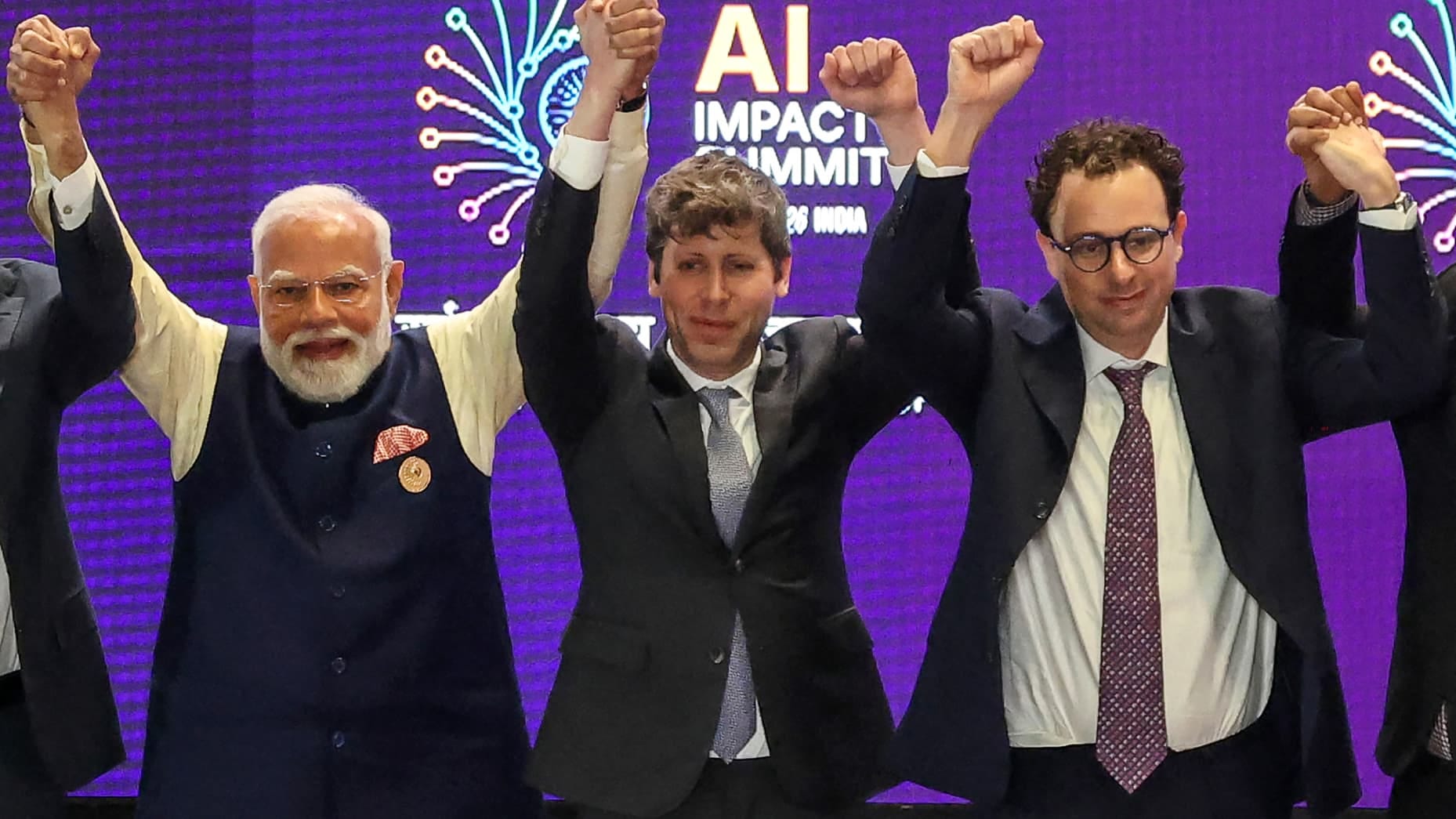
The Pentagon’s strategy was divide and replace. Cancel Anthropic, move to OpenAI or Google, get the contract language it wanted from someone more compliant. It almost worked. These are fierce competitors. Amodei co-founded Anthropic in 2021 after leaving OpenAI along with other colleagues. He and OpenAI CEO Sam Altman declined to hold hands during a group photo with Prime Minister Modi at India’s AI Impact Summit last week, raising fists while every other leader on stage clasped hands.
Then Altman sent a memo to his staff Thursday night. OpenAI shares Anthropic’s red lines, he wrote. No mass surveillance. No autonomous lethal weapons. Humans in the loop for high stakes decisions. An open letter signed by more than 300 Google employees and over 60 OpenAI employees appeared by Friday morning: “They’re trying to divide each company with fear that the other will give in. That strategy only works if none of us know where the others stand.”
They stood together. A bipartisan group of senators, Wicker, Reed, McConnell, and Coons, sent a private letter urging the Pentagon to extend its deadline and return to the table, a sign that even the military’s congressional allies were uncomfortable with the pressure campaign.
By the time Trump posted, the Pentagon had no credible replacement, no congressional cover, and no industry ally willing to take the contract on its terms.
The skepticism worth holding
Anthropic was already inside. They took the $200 million. Their model runs on the Pentagon’s classified networks through a partnership with Palantir, the data analytics company that has built surveillance infrastructure for immigration enforcement and law enforcement agencies across the country. Anthropic does intelligence analysis for what the Trump administration now calls the Department of War.
The line they drew is real. Surveillance of Americans and autonomous killing are not small things to refuse. But the line was drawn here, at this moment, while already doing substantial military work on classified systems. That’s not nothing. And it is not the same as refusing to work with the military.
Name it. Write it down. Make it possible for someone else to check. Anthropic asked for that. The government’s answer was a Truth Social post calling them enemies of the Constitution.
What the six months means
This is not a story about AI companies as heroes. The hero framing flattens what actually happened and lets everyone off too easy.
The six-month phaseout is the Pentagon admitting the line was real enough to matter. You don’t need six months to replace something that wasn’t load-bearing. Claude is embedded in classified systems doing work the military depends on, and there is no adequate substitute ready. The president could call Anthropic woke. He could not actually remove them by Friday.
That gap, between what the government said it would do and what it could actually do, is where the written constraint did its work.
The lesson isn’t trust the AI companies. The lesson is that vague assurances aren’t limits. Written specificity is the only thing that can be held to. The communities organizing in Minneapolis have been saying this all year. If it’s lawful, say exactly what that means. Name it. Write it down. Make it possible for someone else to check.
That is not a radical ask. It is the minimum condition for accountability.
Today, a president called a company treasonous for making that ask. And then gave them six months because he couldn’t actually do without them.
Anthralytic is a strategy and evaluation studio that helps mission-driven teams clarify and amplify their impact.