

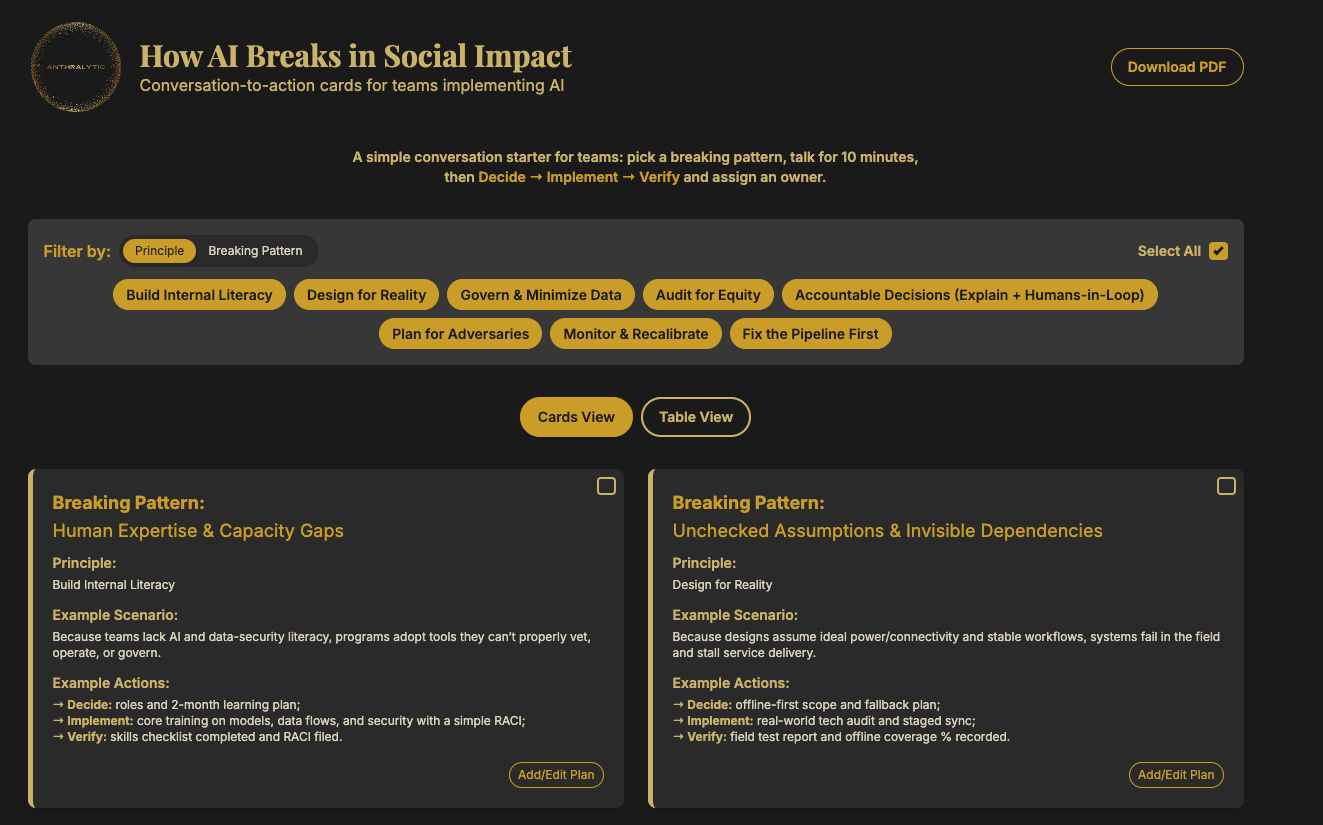
Before I jump in, I won’t bury the lede. Here is a tool we created to help teams talk through and develop actions for implementing AI:
The potential for AI to improve social impact work is transformative. It can help us spot patterns sooner, target resources better, and bring lived experience into decisions at scale—if we build for the world we actually work in. It’s early and very much in learning mode, but innovative evaluators like Steve Powell, Pete York, Steffen Bohni Nielson, Francesco Mazzeo Rinaldi, and Gustav Jakob Peterson—among others—are setting real precedents.
Some other examples are UNDP’s Independent Evaluation Office (IEO) and the UN World Food Programme (WFP). Along with the UN’s tech center (UNICC), IEO built Artificial Intelligence for Development Analytics (AIDA) which reads thousands of evaluation reports and pairs paragraph-level Natural Language Processing (NLP) with sentiment so managers can see where UNDP performs well and where it does not. WFP runs HungerMap LIVE, which fuses multiple data streams—and, in some deployments, public sentiment—in near real time (e.g., during COVID across 90+ countries) to guide rapid course corrections.
The goal of AI in these instances isn’t to replace human judgment, but to make analysis more context-aware, more explainable, and ultimately more useful to the people, communities, and organizations we serve. I strongly believe that the right answer is not to just ignore AI. Then we forfeit all of the opportunities to enhance impact it brings. But we have to use it safely and wisely.
This finale turns the last four installments (plus side quests) into a field-ready blueprint: the recurring failure patterns and the moves that keep you out of them.
More about the tool below.
The Blueprint
The first four pieces in this five part series raised a lot of questions about social impact data and AI, but I’ve tried to leave you with concrete actions for each of the following ways they break:
Data vulnerabilities
Infrastructure
The human element
The regulatory minefield.
In short, some important actions are:
1) Get People AI-Ready!
This is the most crucial piece. Most orgs lack internal AI/data-security expertise, making it hard to vet tools, challenge vendors, or operate safely.
Move: Train for model basics, data flows, limitations, and ethical risk—so teams can question assumptions, interpret outputs, spot issues early, and adapt on the fly.
2) Design for the world you’re in
Ground everything in context. Don’t just check for signal bars. Audit power reliability, connectivity, staff digital literacy, and failure modes.
Moves: Prefer offline-capable tools that sync later; know where servers live and the physical routes data takes (yes, undersea cables)—if one link can break you, add a backup; train/document locally; start small, test in rough conditions, then scale; consider edge computing/edge AI where it fits.
Pre-launch check: Run a social-context risk/readiness assessment—map incentives, test likely workarounds, and verify datasets are representative, current, and locally compliant.
3) Keep systems accountable, but fair and transparent
Map → Minimize → Explain
Map: Fairness and explainability only work if you know where data comes from, where it goes, and who touches it. Access and accountability are key. Document end-to-end flows and storage/jurisdictions. Use role-based access, lineage/audit logs, and contracts/DPIAs aligned to your actual flows, consent/appeal channels for the people whose data you hold.
Minimize: collect and retain only what’s essential. It sounds simple, but it takes more effort than liberally collecting and storing data.
Explain, with equity: Audit inputs and outputs with affected communities; avoid black boxes in high-stakes use—require interpretable rationales; set confidence thresholds and escalation protocols for human override; assume confident wrongness—validate with evidence.
4) Anticipate adversaries—and friends who bend the rules
People will game systems (sometimes to survive, sometimes to “help”). Expect it.
Move: Map incentives, test adversarial inputs, secure training/input pipelines, and keep feedback loops open so rules adapt without eroding trust.
5) Monitor and recalibrate
Conditions shift; models degrade.
Move: Go beyond lab accuracy—run distributional robustness tests across populations/geographies/seasons/shocks; monitor out-of-distribution errors and set retraining triggers after disruptions (climate, policy). Stand up a rapid-response team with a simple incident-reporting playbook; define kill-switch triggers (harm threshold, performance drop, legal risk) and who pulls the plug. Build fallbacks. If the AI fails, what’s the manual plan?
6) Demand explainability where stakes are high
Opacity and emergent behavior are real. Expect it.
Move: Avoid black-box tools for consequential decisions; choose vendors and models that make reasoning and limitations legible.
7) Fix the pipeline first
I worked with a Security Director who used to say: "bad news doesn’t get better with age.” In that same vein: bad data doesn’t get better with automation. Automation scales everything—including bad practices.
Move: Clean data, clarify governance, and harden security before you add AI.
8) Operate above the minimum
Regulation is uneven and slow.
Move: Set ethical guardrails now—aligned with communities—and create channels for them to shape how their data and lives are affected.
The Tool
I’ve aggregated all of the lessons from the series into a free, interactive tool that turns lessons on responsible AI into concrete action plans for your team. Kick off the conversation and start implementing AI the right way.
Again, here is the free tool:
Catch up on the series + side quests
Thanks for reading! I hope you enjoyed the series. If you missed any of the installments, side quests or podcasts here are the links:
Core series and related posts
Five Ways AI Breaks in Social Impact (Intro to the Series)
1 of 5: Social Impact Data Vulnerability in Three Acts - (Article)
2 of 5: How AI digital infrastructure breaks in social impact - Is your New $15,000 Data System a Glorified Clipboard? (article)
3 of 5: How People Break AI in Social Impact - Gaming, Bias, and the Human Element(Article)
4 of 5: Data Privacy, Sovereignty, and Surveillance in Social Impact - Avoid the AI Regulatory Trap: A Quick Cheat Sheet for Privacy, Sovereignty & Surveillance Risks
Pods
Social Impact Data Vulnerability in Three Acts (Podcast version)
How fragile data, weak governance, and good intentions collide—and how to stop AI from multiplying the risk.
Is Your $15,000 Data System a Glorified Clipboard? (Podcast version)
Why infrastructure assumptions (power, sync, support) turn “smart” systems into expensive notebooks—and how to design for the field, not the demo.
How People Break AI in Social Impact (Podcast)
Why gaming and “helpful” tweaks tank models—and how to close the feedback loop without breaking trust.
Side Quests
Side Quest #1: Choose Your AI Tool Wisely (article)
Pick tools that fit your context, not a vendor deck.
Side Quest #2: The Sync Loop of Doom (article)
Side Quest #2: The Sync Loop of Doom (podcast)
Why online-only workflows crumble in low connectivity—and how offline-first plus staged sync keeps programs running.
Side Quest #3: GPT OSS Breaking News Edition
Side Quest #3: GPT OSS Breaking News Edition (podcast)
What open-source LLMs mean for privacy, control, and on-device AI in low-resource settings.
Side Quest #4: The Side Quest that Changes the Game (podcast)
Side Quest #4: The Side Quest that Changes the Game (article)
Tech Tyrant, Human Wildcard, Context Colossus—and how to survive them together.